Know whether this booking will hold -- before you commit.
When a receiving window changes, Safe-to-Commit tells you whether your specific booking is still safe to commit to execution -- or whether the plan needs to change.
The commit chain
You lock the whole chain in one decision - before the window is final
Order to terminal in-gate is a single committed sequence. The moment you commit, the load and the move are set - but the deadlines at the terminal are controlled by two other actors and keep moving. Safe-to-Commit forecasts whether they will hold before you lock.
Rail commits you 10 to 14 days out - the outer edge our model still reaches - so a late cut move can strand a box already on the train. Safe-to-Commit flags about 92% of rolls 7 to 12 days ahead, so you adjust the production plan and container dropoff early, instead of at the last minute.
Illustrative example. The verdict, vessel, and lead times shown are for illustration; the forecast window reflects the current model frontier.
The decision that cannot be undone.
Once you commit container dropoff -- drayage dispatched, container stuffed, documentation filed -- the execution clock starts. If the receiving window moves after that moment, your options narrow significantly. Safe-to-Commit is the evaluation that happens before that clock starts.
Is this booking still safe to commit to execution, given the current receiving window and production readiness?
What Safe-to-Commit produces.
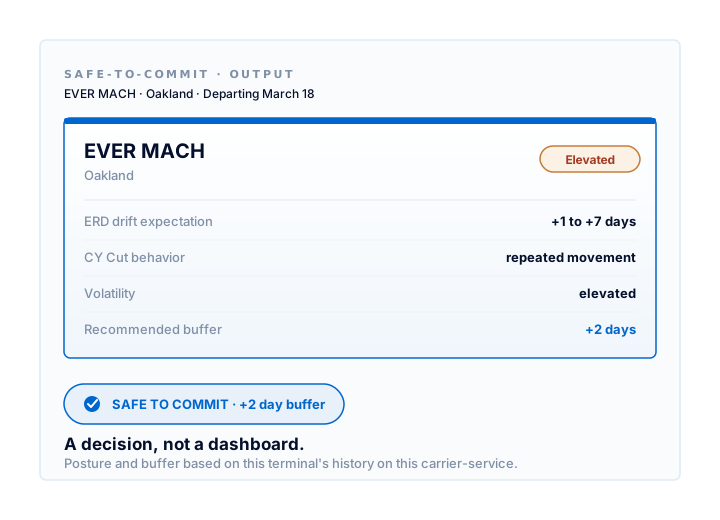
One booking. One recommendation. Not a dashboard to interpret.
This is not a dashboard. This is a decision. The recommended buffer and posture are based on the terminal's historical behavior on this carrier-service combination -- with a record of what you knew when you decided.
What Safe-to-Commit evaluates.
The receiving window
Safe-to-Commit evaluates the current ERD and CY cutoff state against the terminal's historical drift behavior on this specific carrier-service combination. Not the market average -- this lane.
Production readiness
For exporters, the receiving window is only half the equation. Safe-to-Commit accounts for fumigation cycles, lab certification timelines, equipment availability, and rooms-ready status -- the upstream steps that cannot be compressed if the window shifts.
The decision
Safe-to-Commit or Not Safe-to-Commit. When the posture is Not Safe, the output includes the specific pattern driving the risk and the recommended buffer before committing. A record of what the schedule showed when the call was made is retained automatically.
For drayage teams: Safe-to-Dispatch applies the same evaluation at the dispatch moment -- before the truck moves.
Ready to see this on your bookings?
Safe-to-Commit is part of the Ava decision layer. It evaluates your specific bookings against terminal volatility patterns -- not portfolio averages.
Exporters and logistics partners already operating on TradeLanes





Frey Commodities
"TradeLanes gives us control over the entire load order process, in real time. I highly recommended signing up to try their new early access product."