Know whether it's safe to dispatch -- before the truck moves.
Safe-to-Dispatch evaluates the receiving window, the in-gate appointment, and the terminal's current state before you commit the dispatch -- so the truck moves only when the window is confirmed open.
The dispatch board
You are not gating one box - you are sequencing a converging week
A dispatcher plans 30 to 50 loads per vessel across several vessels calling the same terminal. When their windows converge - 49% of Oakland days have 3 or more vessels opening at once - every load competes for the same finite gate hours, and the window compresses exactly when demand peaks. Safe-to-Dispatch sequences the week: which vessel's loads move first, which buffer, which appointment to reschedule.
You do not find out it is a convergence week until Monday evening - after Friday's commit. Safe-to-Dispatch flags the stack days in advance and sequences the loads by window stability, so the week is planned, not fought.
Illustrative example. Vessels, loads, and windows shown are for illustration; convergence and compression figures are from West Coast terminal observations, Jan 2025 - Mar 2026.
The dispatch decision is a forced bet.
The dispatcher commits T-1 -- the afternoon before the move -- because the schedule will not hold further out. In-gate appointments are booked 2 to 3 days in advance under terminal appointment scarcity. Both clocks run independently. When the receiving window moves, both are misaligned simultaneously: the appointment is in the wrong slot and the dispatch call is based on stale data. Safe-to-Dispatch reconciles both before the truck leaves.
Is it safe to dispatch to this terminal, on this vessel, right now -- given the current window state and the appointment held?
The dispatch chain
You commit the move in one call - the afternoon before the gate
The dispatch is a forced bet. The appointment is booked 2 to 3 days out under gate scarcity; the dispatch call itself comes at T-1, the afternoon before the move. Both clocks run independently - and when the receiving window shifts, both are misaligned at once. Safe-to-Dispatch reconciles them before the truck moves.
You commit the dispatch at T-1, but the appointment was locked 2 to 3 days earlier - if the window moved in between, both are in the wrong slot. Safe-to-Dispatch reconciles the window and the appointment before the truck moves, so you avoid a dry run and a wasted slot.
Illustrative example. The verdict, vessel, and lead times shown are for illustration; the confirmation window reflects the current model frontier.
What Safe-to-Dispatch produces.
One dispatch. One recommendation. Not a dashboard to interpret.
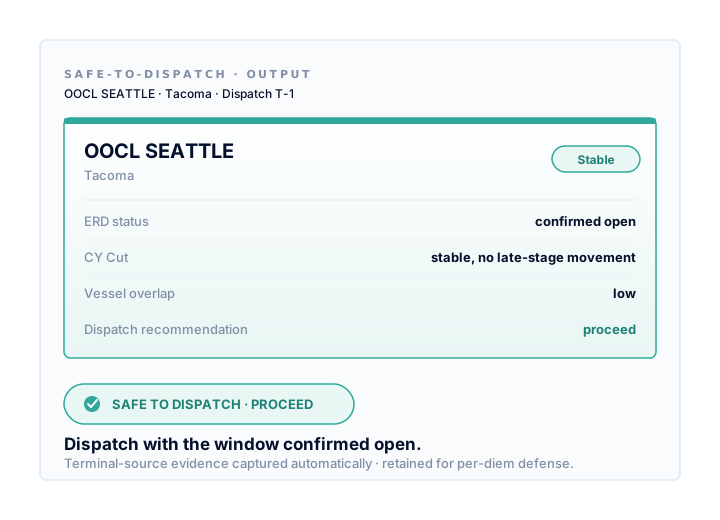
Safe-to-Dispatch. The window is confirmed open, the appointment slot is valid, and no late-stage compression has been detected -- with a record of what the schedule showed when the dispatch call was made.
What Safe-to-Dispatch evaluates.
The receiving window
Safe-to-Dispatch evaluates the current ERD and CY cutoff against the terminal's live state and historical behavior on this service. Terminal-verified ERD -- not what the carrier publishes, what the terminal is actually showing.
The appointment and capacity
Safe-to-Dispatch checks whether the appointment slot is still valid against the current window, flags bunched-vessel risk when multiple vessels have pushed ERDs onto the same day, and accounts for gate throughput constraints that determine whether an on-time arrival can actually in-gate.
The decision
Safe-to-Dispatch or Hold. When the posture is Hold, the output includes the specific condition to monitor and the earliest re-evaluation point. Timestamped terminal-source evidence is captured automatically -- retained for per-diem dispute defense.
For export planning teams: Safe-to-Commit evaluates whether a booking is safe to commit before execution begins.
Ready to see this on your dispatches?
Safe-to-Dispatch is part of the Ava decision layer. It evaluates your specific dispatch timing against terminal volatility patterns and live window state -- not carrier-aggregated data.
Exporters and logistics partners already operating on TradeLanes





Frey Commodities
"TradeLanes gives us control over the entire load order process, in real time. I highly recommended signing up to try their new early access product."