A data-driven case for separating pricing volatility from execution volatility in ocean freight.
Index-linked pricing has improved ocean freight contracts.
It aligns rates with market conditions.
It reduces renegotiation friction.
It improves financial predictability.
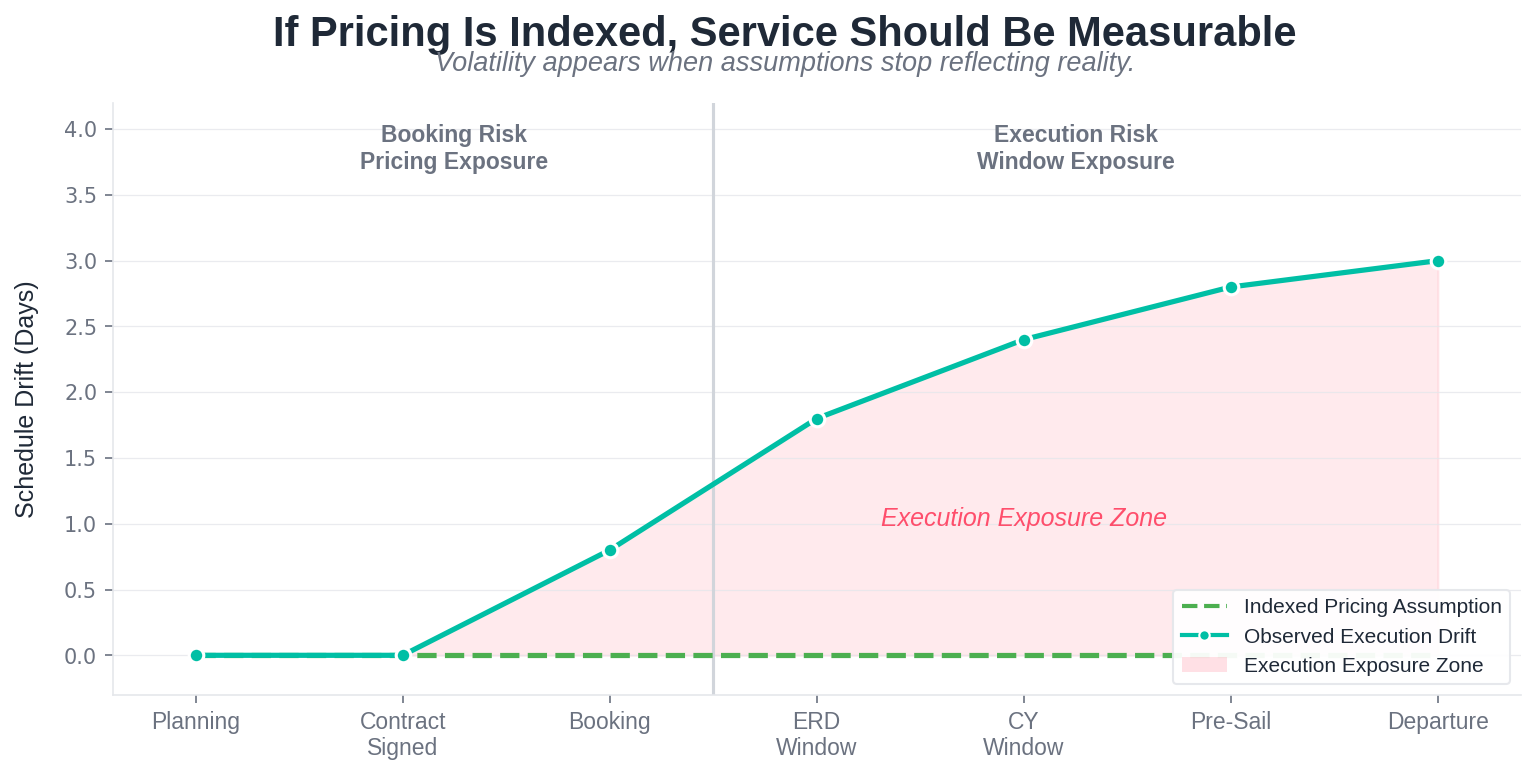
But pricing is only half the exposure.
Service instability - window compression, late-stage changes, roll risk - is where operational damage occurs.
If we can index price objectively, the next question is:
Can we measure service instability objectively enough to support predefined service triggers?
What We Measured
We analyzed one year of US export vessel schedule data:
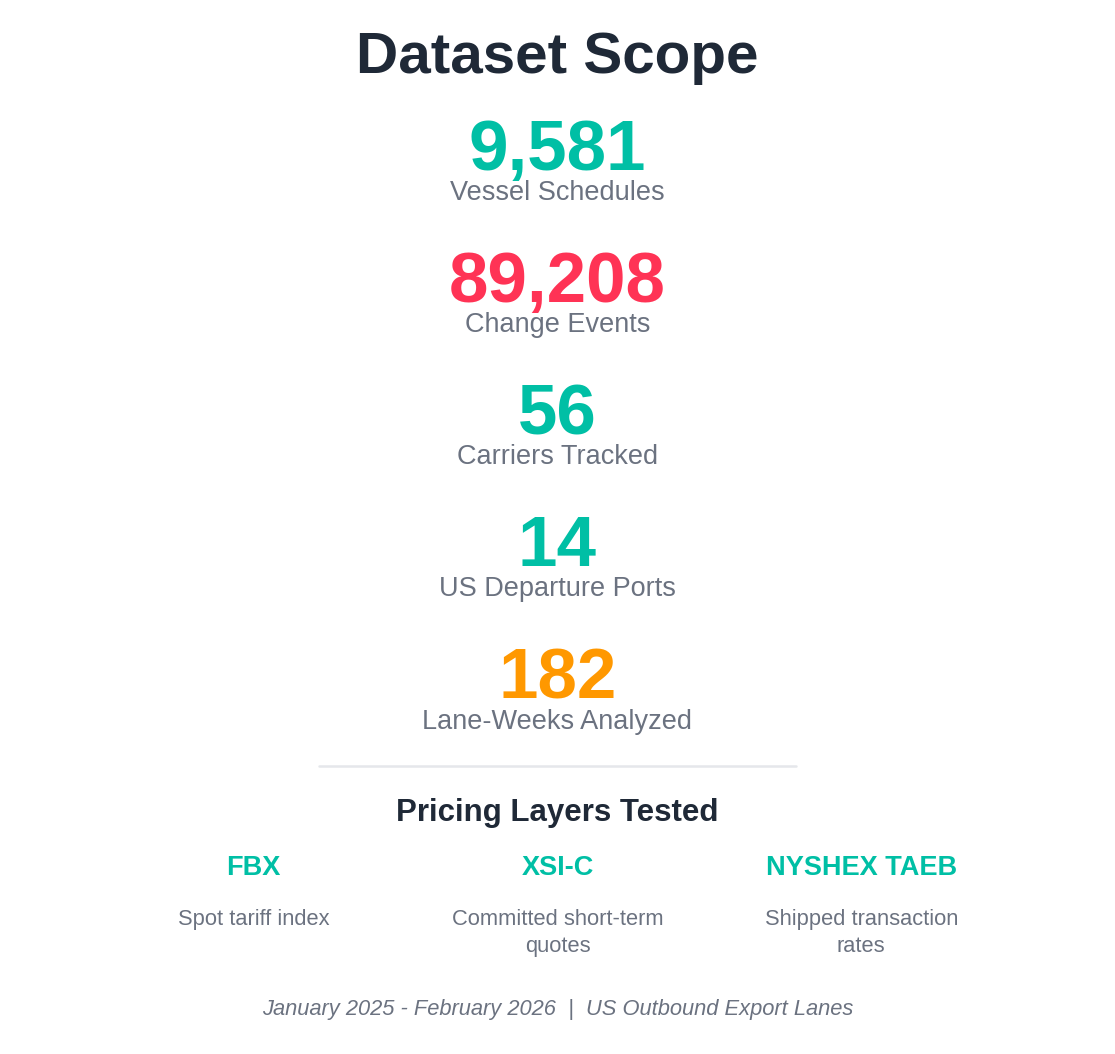
- 9,581 vessel schedules
- 89,208 schedule change events
- 56 carriers
- 14 US ports
- 182 joined lane-weeks across three major export lanes
We then tested execution instability against three independent freight rate indices representing different pricing layers:
- FBX - carrier spot tariffs
- XSI-C (Xeneta Shipping Index) - committed short-term quotes
- NYSHEX TAEB - shipped transaction rates
Each index reflects a different stage of the booking lifecycle:
- Spot pricing
- Committed pricing
- Invoiced, shipped pricing
This allows us to test whether execution instability is simply a reflection of rate volatility - or whether it operates as a structurally distinct risk layer.
ERD Drift - How Far the Window Moves
ERD drift measures how much the earliest receiving date moves from its original publication.
From the pooled lane-week data:
- p50 = 0 hours
- p75 = 102 hours
- p90 = 197.6 hours
That means:
In 25 percent of weeks, the median ERD shift exceeded 4 days.
In 10 percent of weeks, it exceeded 8 days.
This is not trivial movement.
It is measurable structural drift.
Figure 2 - ERD Drift Distribution
ERD drift has measurable distribution bands suitable for objective thresholds.
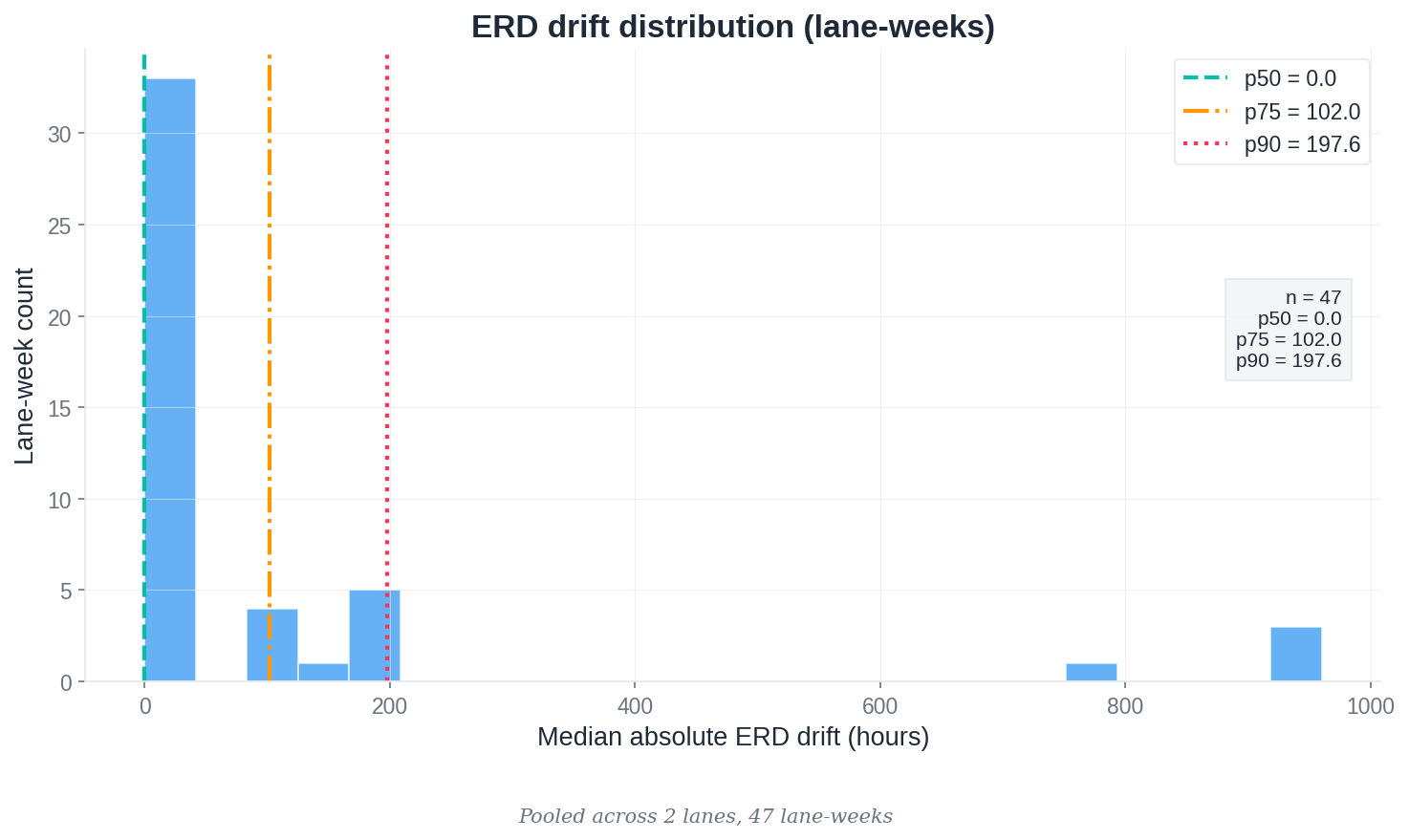
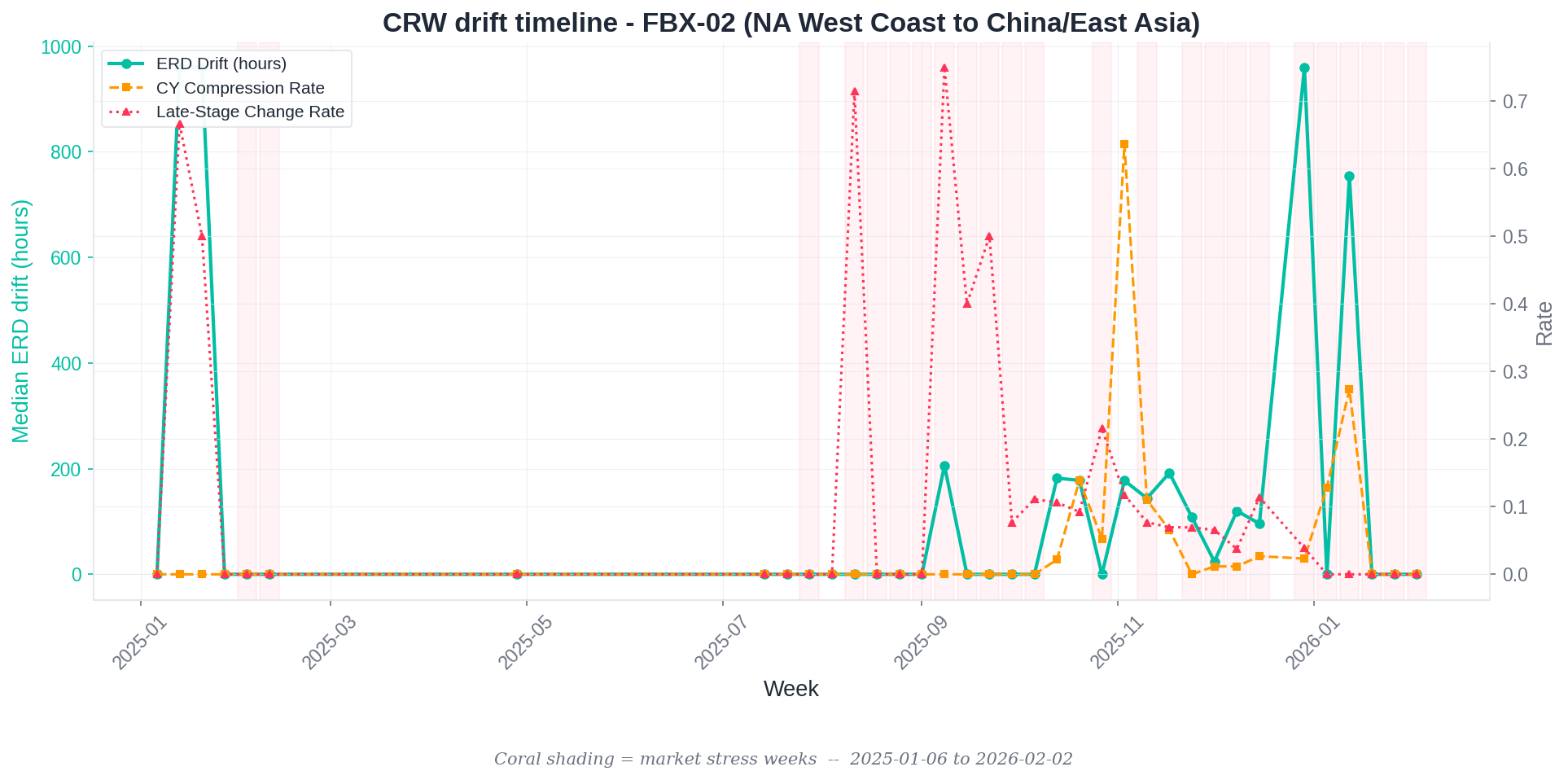
Figure 3 - ERD Drift Timeline by Lane
Elevated drift clusters across consecutive weeks, indicating structural instability rather than isolated noise.
CY Compression Rate - When Cutoffs Tighten
CY compression captures how often the cutoff advances after ERD start.
From the pooled distribution:
- p50 = 0.000
- p75 = 0.006
- p90 = 0.084
Most weeks see minimal compression.
But in elevated regimes, compression jumps sharply.
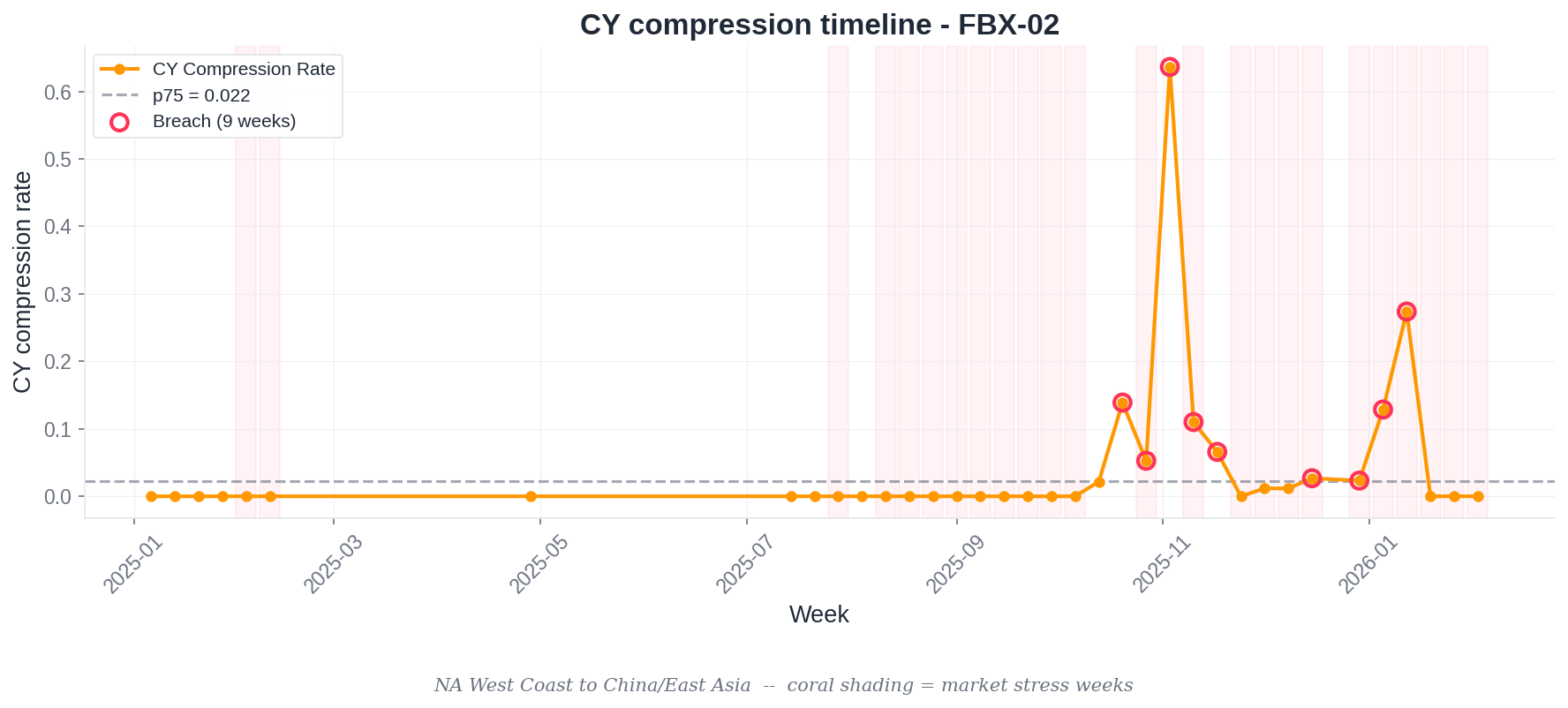
In the FBX-02 lane:
- Trigger threshold (p75) = 0.022
- 9 weeks breached this threshold
Figure 4 - CY Compression Distribution
Cutoff compression exhibits regime-level spikes that can support objective service triggers.
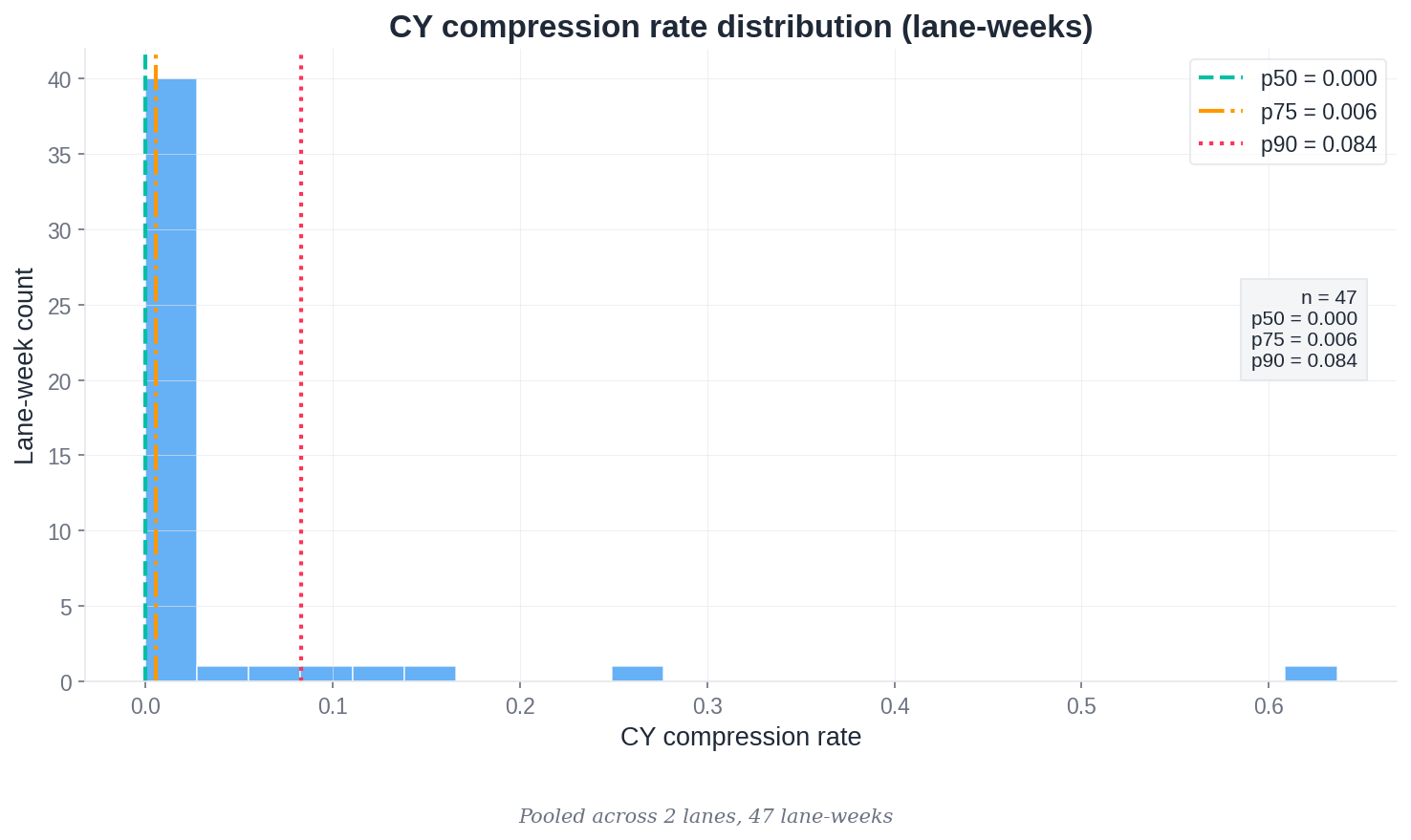
Figure 5 - CY Compression Timeline
Compression spikes cluster in identifiable instability periods rather than appearing randomly.
That clustering makes rule-based triggers viable.
Late-Stage Change Rate - Instability Inside 72 Hours
Late-stage changes inside 72 hours of ERD represent operational strain.
From 35,195 enriched change events:
- 7,742 events (29.1 percent) occurred within 72 hours of ERD or after.
Nearly one-third of material schedule changes occur inside the most operationally sensitive window.
In FBX-02:
- p75 threshold = 0.112
- 9 weeks breached this threshold
Figure 6 - Late-Stage Change Density
Instability accelerates inside the most operationally sensitive window.
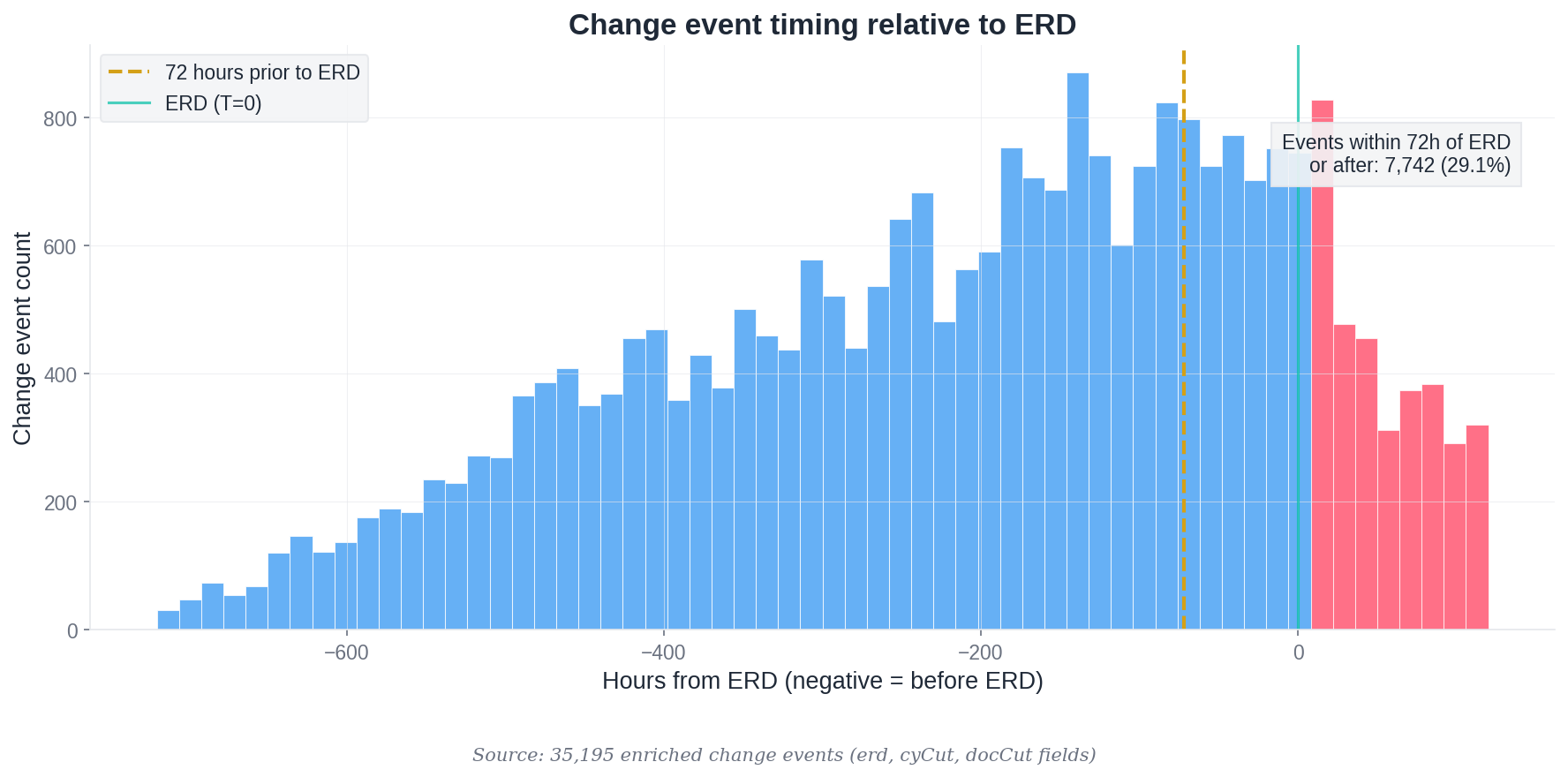
Figure 7 - Late-Stage Change Timeline
Late-stage change density rises materially in high-instability regimes.
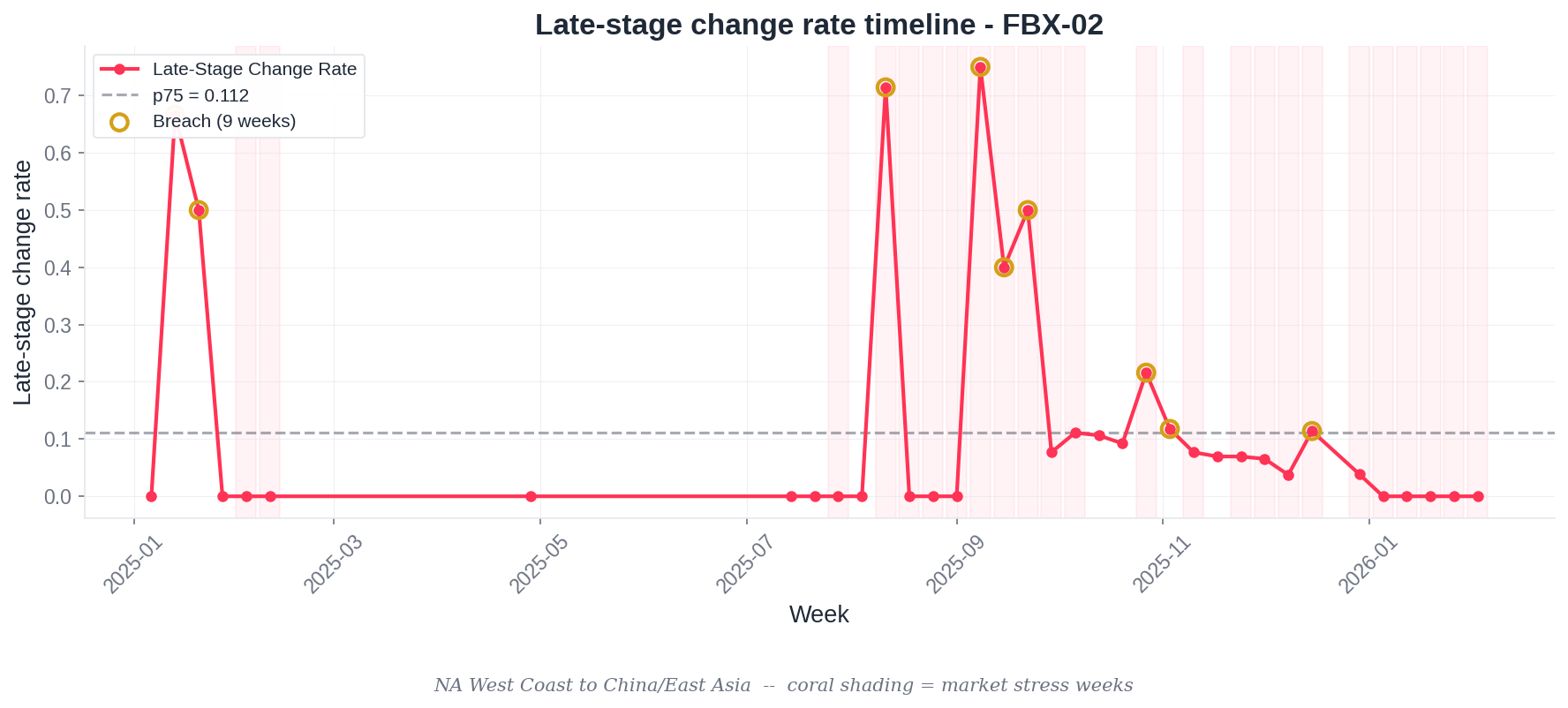
Instability accelerates as departure approaches.
SAFE-to-Gate Coverage - Decision Exposure
We use a conservative proxy (implied_safe_coverage = 1 - high_ARG_week) for illustration.
As execution instability rises, SAFE coverage declines sharply.
Figure 8 - SAFE Coverage vs Instability
As window instability rises, certifiable volume declines, supporting allocation flexibility triggers.
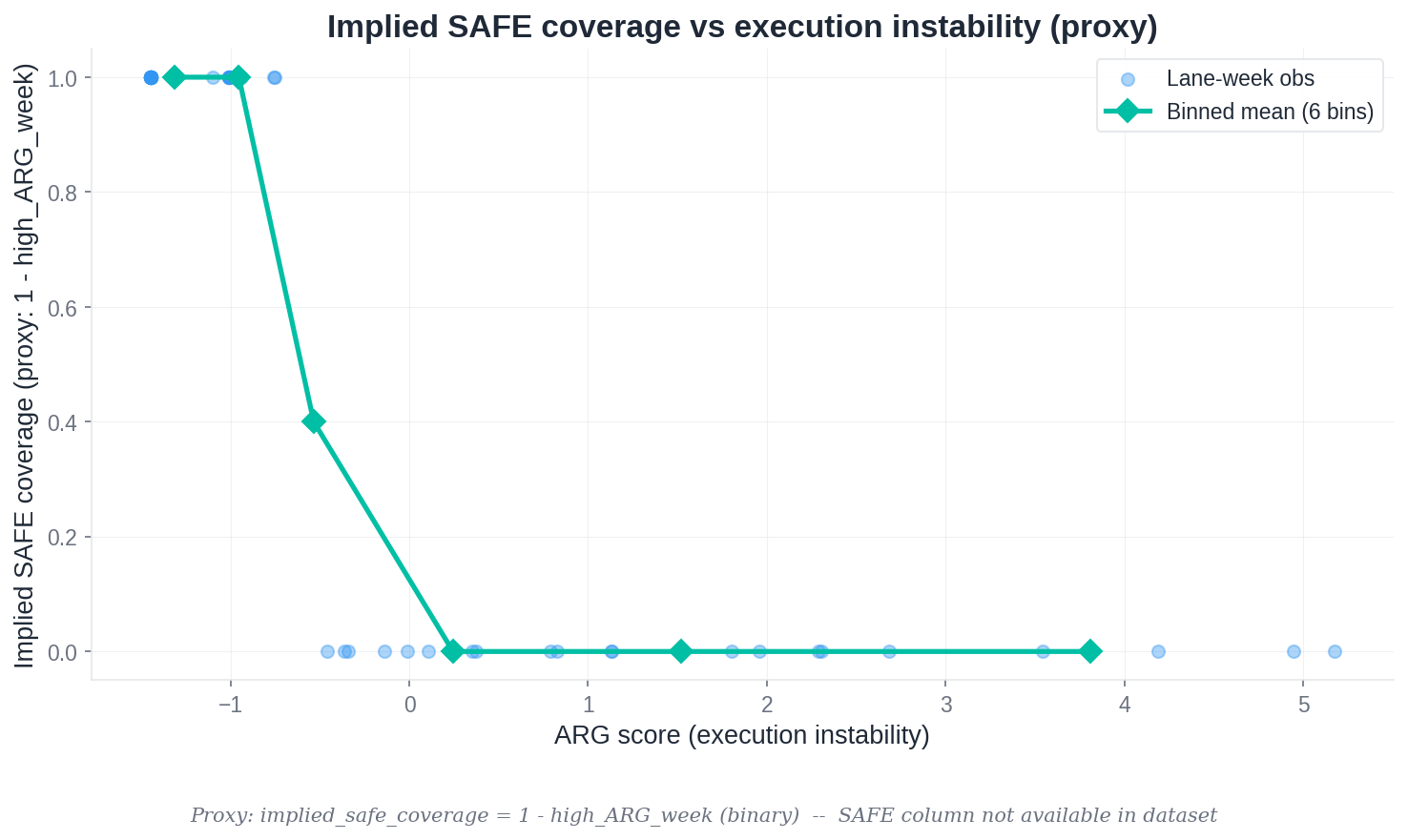
The relationship is nonlinear.
Beyond a defined instability threshold, certifiable volume drops sharply.
That makes execution instability directly relevant to allocation flexibility.
Pricing vs Execution - Tested Across Three Index Families
We tested whether execution instability correlates with:
- Spot tariff volatility (FBX)
- Committed quote volatility (XSI-C)
- Shipped transaction volatility (NYSHEX TAEB)
The results are consistent:
- Some lane-level correlations exist in specific cases.
- Pooled effects across lanes are weak. For example, pooled Spearman correlations between volatility and ERD drift are statistically insignificant and near zero.
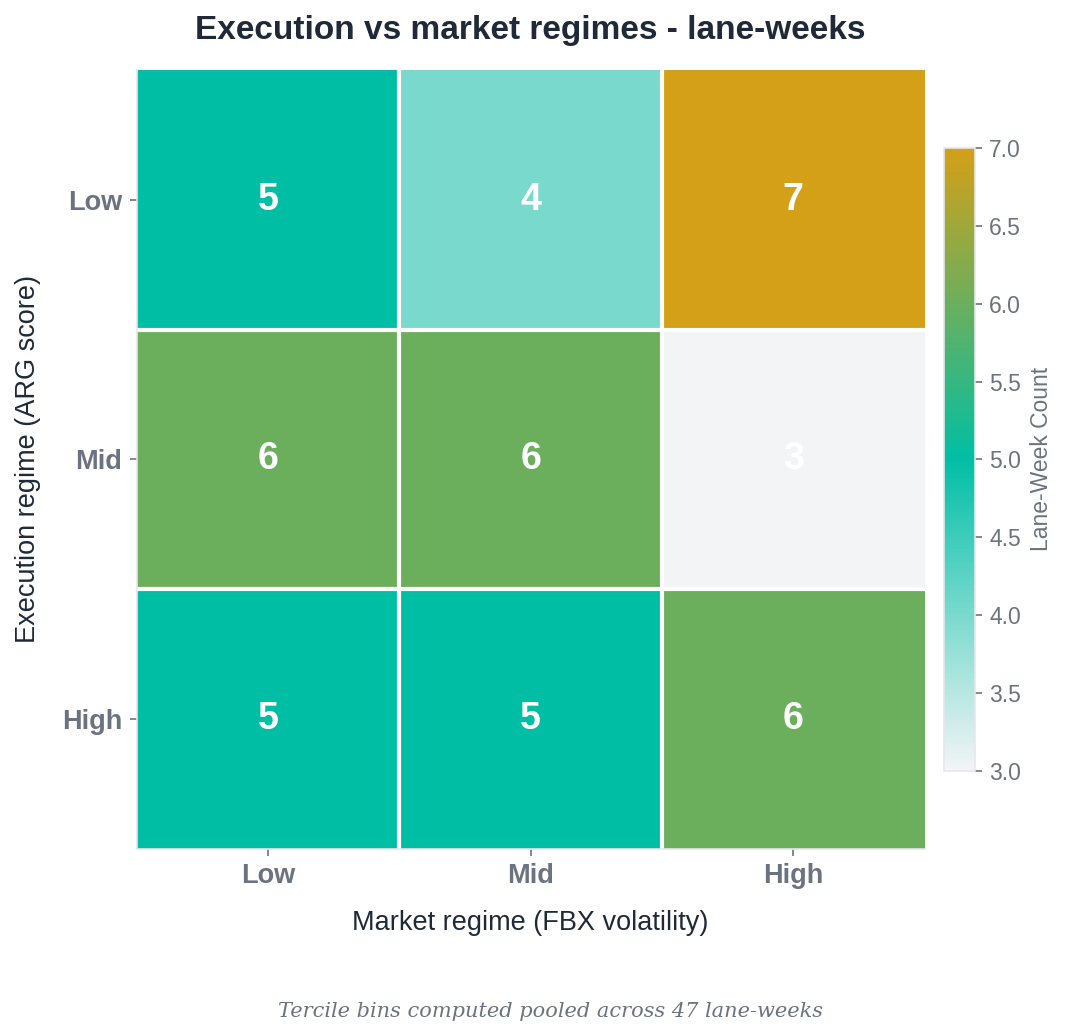
- Stress regimes do not reliably increase execution breakdown.
- Schedule-only models materially outperform price-only models in predicting high-instability weeks.
- That does not diminish the value of index-linked pricing. It clarifies that pricing and execution operate on different volatility dimensions.
In other words:
Execution instability is not simply pricing volatility showing up operationally.
It has its own structure.
It clusters in regimes.
It crosses percentile thresholds independent of pricing method.
This pattern holds whether pricing is measured via:
- Spot tariffs
- Committed quotes
- Shipped transactions
That makes the execution signal robust across spot, committed, and shipped pricing methodologies.
Robustness Across Pricing Methodologies
We repeated the volatility tests across three pricing sources:
- FBX (spot tariffs)
- XSI-C (committed quotes)
- NYSHEX TAEB (shipped transactions)
Figure 9 - Robustness Across Pricing Methodologies
Execution instability metrics remained primarily driven by schedule geometry rather than pricing volatility.
Correlations vary by lane, but no pricing methodology consistently explains execution instability.
This suggests execution risk should be measured directly rather than inferred from rate volatility.
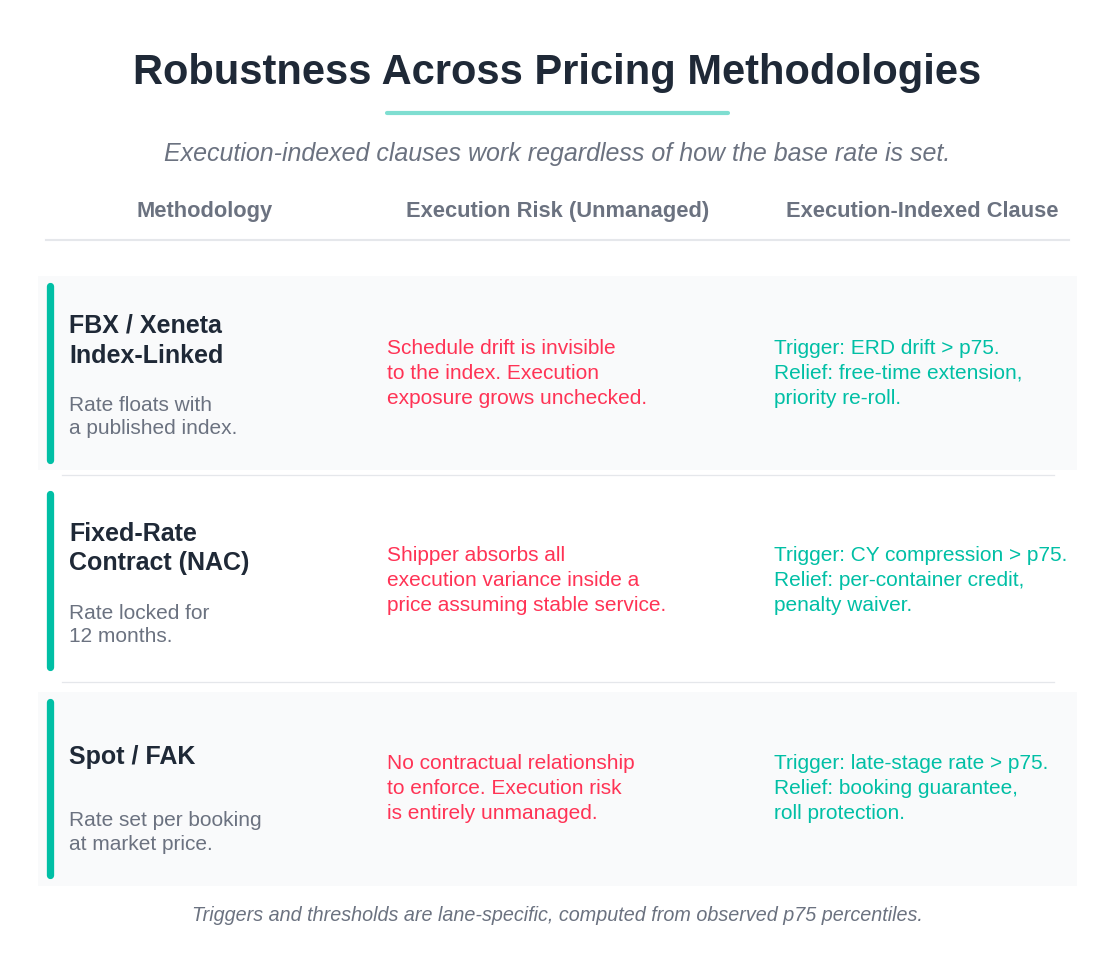
Figure 10 - Correlation Matrix
Execution instability does not strongly correlate with concurrent rate volatility.
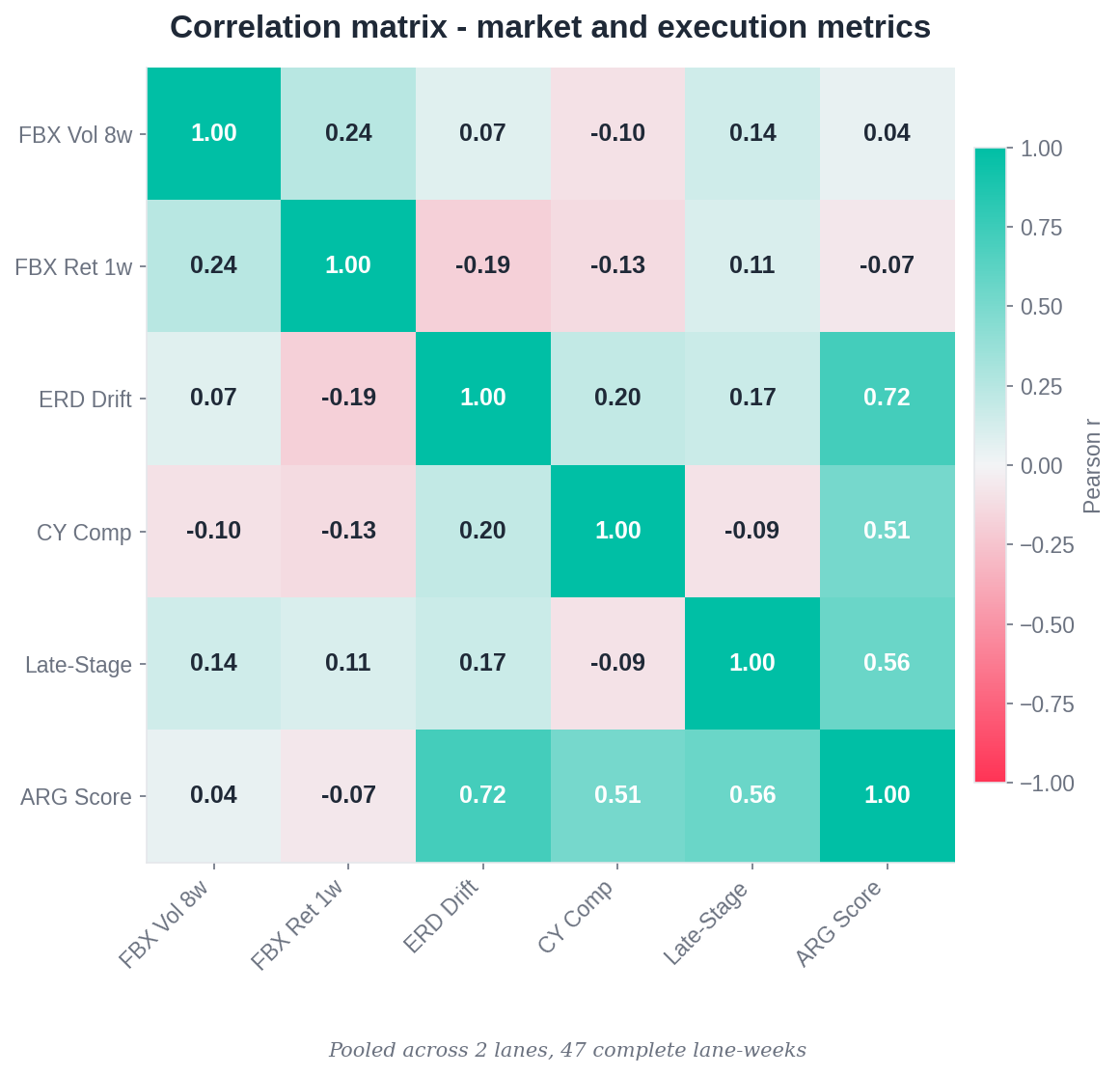
Figure 11 - Market vs Execution Regime Matrix
High execution instability appears across multiple pricing regimes.
What Execution-Indexed Clauses Could Look Like
Because these metrics exhibit percentile structure and regime clustering, contracts can define objective service triggers.
Illustrative examples:
Free-Time Extensions
Automatic Buffer When ERD Drift > p75
In FBX-02:
- p75 ERD drift = 152 hours
- 9 weeks breached threshold
Figure 12 - Free-Time Trigger Simulation
Free-time extensions activate when ERD drift exceeds defined percentile thresholds.
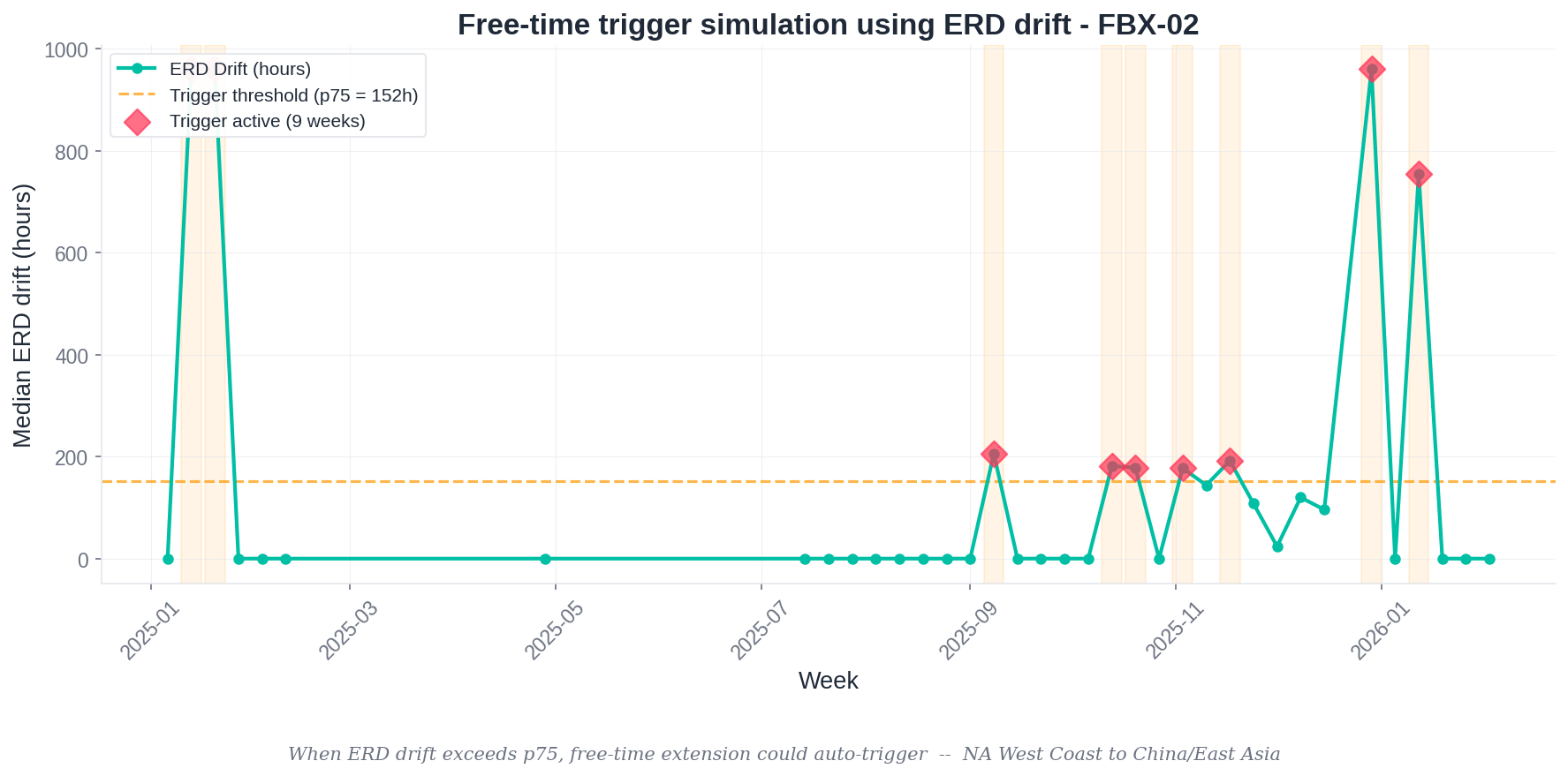
When ERD drift exceeds this band for two consecutive weeks:
Destination free time could automatically extend.
Not as a penalty.
As volatility alignment.
Priority Roll Recovery
Guaranteed Next-Vessel Slot When CY Compression > p75
In FBX-02:
- p75 CY compression = 0.022
- 9 breach weeks observed
Figure 13 - Compression Trigger Simulation
Priority roll recovery activates during measurable compression regimes.
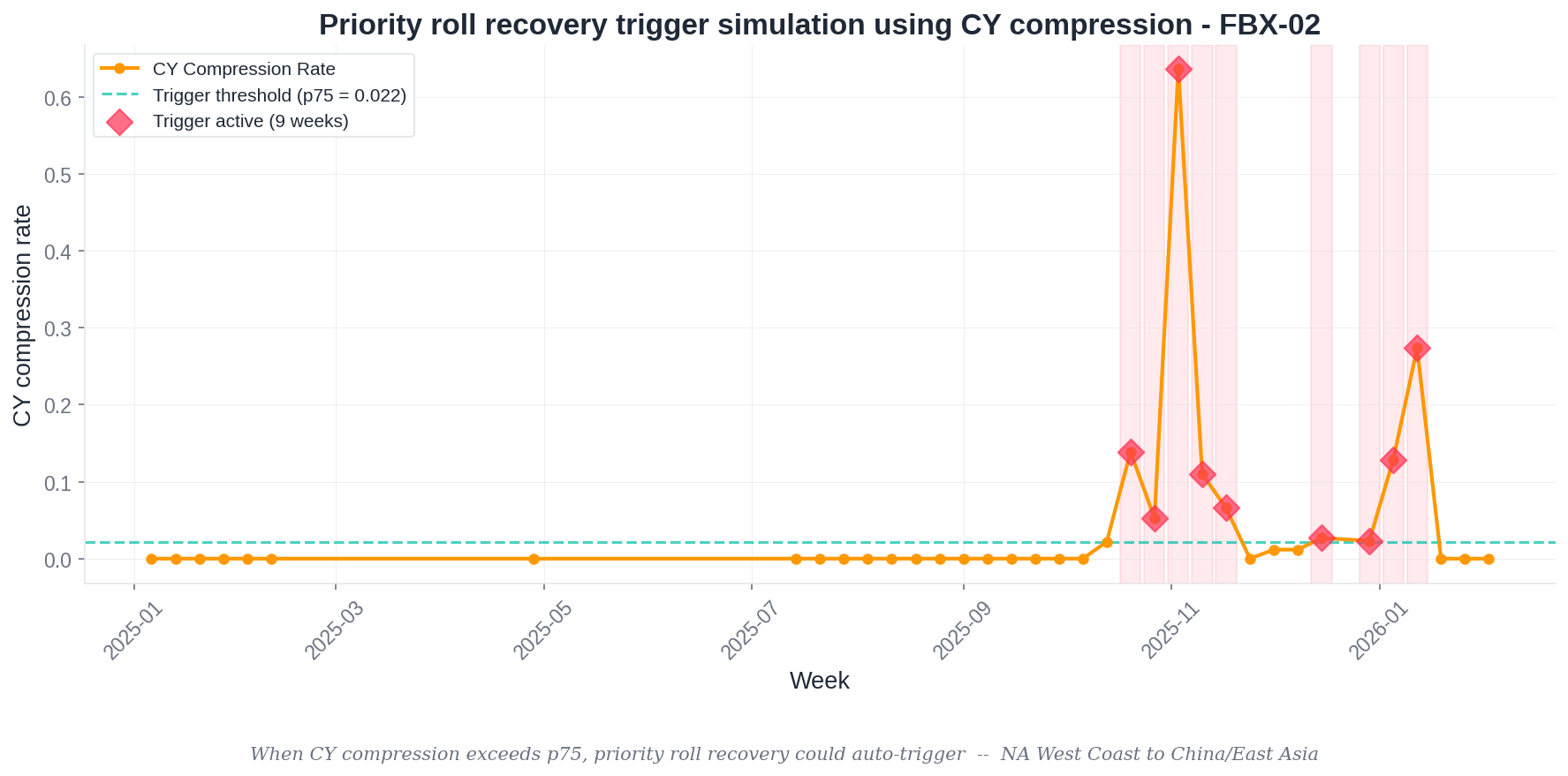
When compression crosses this threshold:
Rolled shipments could receive priority rebooking.
Allocation Flexibility
Cross-Service Reallocation When SAFE Coverage Declines
When implied SAFE coverage declines below defined thresholds:
A portion of contracted volume could be reallocated without penalty.
Figure 14 - SAFE Coverage vs Instability
As window instability rises, certifiable volume declines, supporting allocation flexibility triggers.
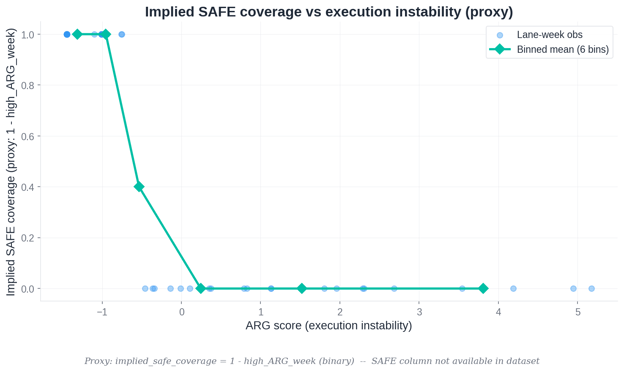
This protects market windows without undermining contract integrity.
The Structural Conclusion
The data shows:
- Execution instability is measurable.
- It has percentile structure.
- It clusters in regimes.
- It supports threshold-based triggers.
- It is largely independent of concurrent rate volatility.
Pricing can be indexed. Service can be measured.
Financial volatility management has matured. Execution volatility management has not.
The data suggests both can be formalized through objective, rule-based mechanisms.
The next step is deciding whether the industry is ready to formalize execution volatility management with the same discipline.
Data Appendix
A detailed data appendix including metric definitions, percentile calculations, trigger thresholds, and statistical tests is available upon request.



Leave a Comment