Methodology Overview
This analysis evaluates ocean carrier reliability through the receiving-window lens, focusing on ERD and CY cutoff behavior rather than vessel arrival times.
Data Scope
- The dataset represents an observational system sample of executable export port-calls and is not a statistically randomized sample.
- Source: carrier schedules, terminal data, historical updates
- Unit of analysis: port-call
- Sample requirements (per carrier analysis): ≥ 32 vessels, ≥ 50 port-calls
Definitions
- Receiving Window: ERD to CY cutoff
- Window Movement: ≥ 1 day ERD or CY change
- Stable Window: < 1 day ERD and CY drift
- Late-Stage Change: change within 72 hours of window opening
Metrics Used
- Stable Window Rate
- Mean ERD Drift (days)
- Mean CY Drift (days)
- Late-Stage Change Rate
- Drift Score (vessel-level severity)
All metrics use absolute drift and calendar days.
What This Analysis Does Not Do
- Rank carriers
- Assign blame
- Measure commercial performance
- Recommend routing or booking decisions
Why This Framework Exists
Traditional ETA-based reliability metrics do not capture the operational reality exporters face inside terminal receiving windows.
This framework exists to measure predictability, not punctuality.
Key Terms and Definitions
Receiving Window
The time period during which export cargo can be accepted at the terminal for a given vessel. Defined in this series as the interval between the Earliest Return Date (ERD) and the CY Cutoff.
Earliest Return Date (ERD)
The first date on which a container may be gated into the terminal for a specific vessel. ERDs may change as vessel schedules or terminal conditions evolve.
CY Cutoff (Container Yard Cutoff)
The final date and time by which a container must be gated into the terminal to be eligible for loading on the intended vessel. CY cutoffs are frequently adjusted closer to execution.
Receiving Window Movement
Any change of one calendar day or more in either the ERD or CY Cutoff between the originally published value and the final observed value.
Stable Receiving Window
A receiving window where both ERD and CY Cutoff shift by less than one calendar day over the observation period.
Drift
The absolute change (in calendar days) between an originally published ERD or CY Cutoff and its final observed value.
ERD Drift / CY Drift
The magnitude of change, in days, for ERD or CY Cutoff respectively. Reported as absolute values for comparability.
Late-Stage Change
A change to ERD or CY Cutoff that occurs within the final 72 hours before the receiving window opens. Late-stage changes are associated with the highest operational impact.
Receiving Window Movement Rate
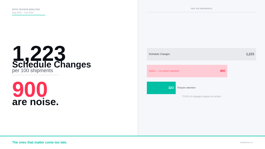
The percentage of port-calls in which the receiving window moved at least once (≥1 day ERD or CY shift).
Port Volatility Index (PVI)
A composite, normalized score (0-10) representing the relative volatility of a port’s receiving windows. PVI incorporates:
- average ERD drift,
- average CY drift, and
- frequency of late-stage changes.
Higher PVI indicates environments where static planning assumptions break more quickly.
Drift Score
A severity indicator used to identify high-impact events, calculated as:
|ERD drift| + |CY drift| + late-stage change flags
Drift Score is used to surface tail-risk scenarios and does not represent average or typical behavior.
Static Buffer
A fixed planning allowance (e.g., “2 extra days”) applied uniformly, regardless of observed volatility or timing of changes.
Dynamic Time Buffer (DTB)
An adaptive planning concept that adjusts buffer expectations based on observed drift behavior, timing, and terminal-specific conditions.
System Baseline
The aggregated, cross-carrier, cross-terminal view of receiving-window behavior used as the reference frame for all carrier-specific analyses in the series.




Leave a Comment