Why most container dropoff decisions are made on windows that were never executable
The assumption everyone is operating under
When a booking gets rolled, the explanation sounds simple:
- The schedule changed.
- The window moved.
- The plan failed.
So the response is also simple:
- Check more often.
- Monitor more closely.
- React faster next time.
But this explanation is wrong.
Not partially wrong. Structurally wrong.
Because it assumes something that is no longer true → That the original plan was executable.
The reality
In most cases, the plan was already broken.
Not at the moment of failure.
At the moment it was first observed.
What actually happens
Export teams receive a booking.
They see:
- ERD (when available)
- CY Cutoff
- A usable receiving window
It looks stable.
It looks wide enough.
It looks actionable.
So they plan:
- Trucking is scheduled
- Warehouse labor is committed
- Containers are positioned
At this point, the decision is already made.
But the window they planned against is not stable.
It is already decaying.
They just cannot see it yet.
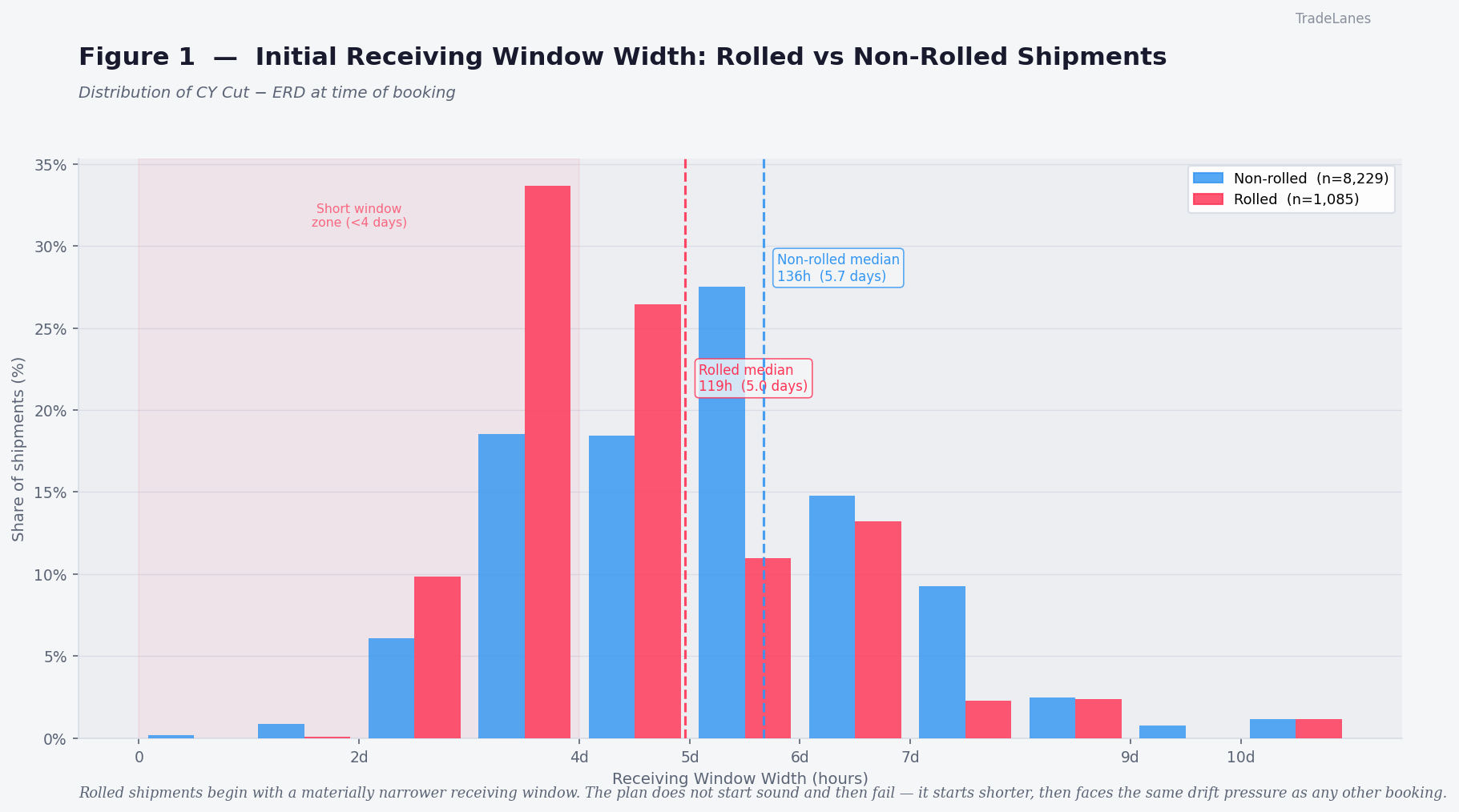
In our dataset of 5,000+ U.S. export departures, the majority of receiving windows will still shift after this point - often multiple times - before the window even opens.
This is the gap between what looks executable and what actually is.
Figure 1 - Initial Receiving Window vs Executable Window
Why this is invisible
Because most systems show the window as a static object.
A date range.
A boundary.
A plan.
But the receiving window is not static.
It is a moving boundary created by:
- carrier updates (CY Cut)
- terminal updates (ERD)
These systems do not coordinate.
They do not reconcile.
They do not expose drift.
So what looks like a clean window is actually: A temporary overlap of two independently moving signals.
The visible window is not the executable window.
Figure 2 - Visible Window vs Executable Window
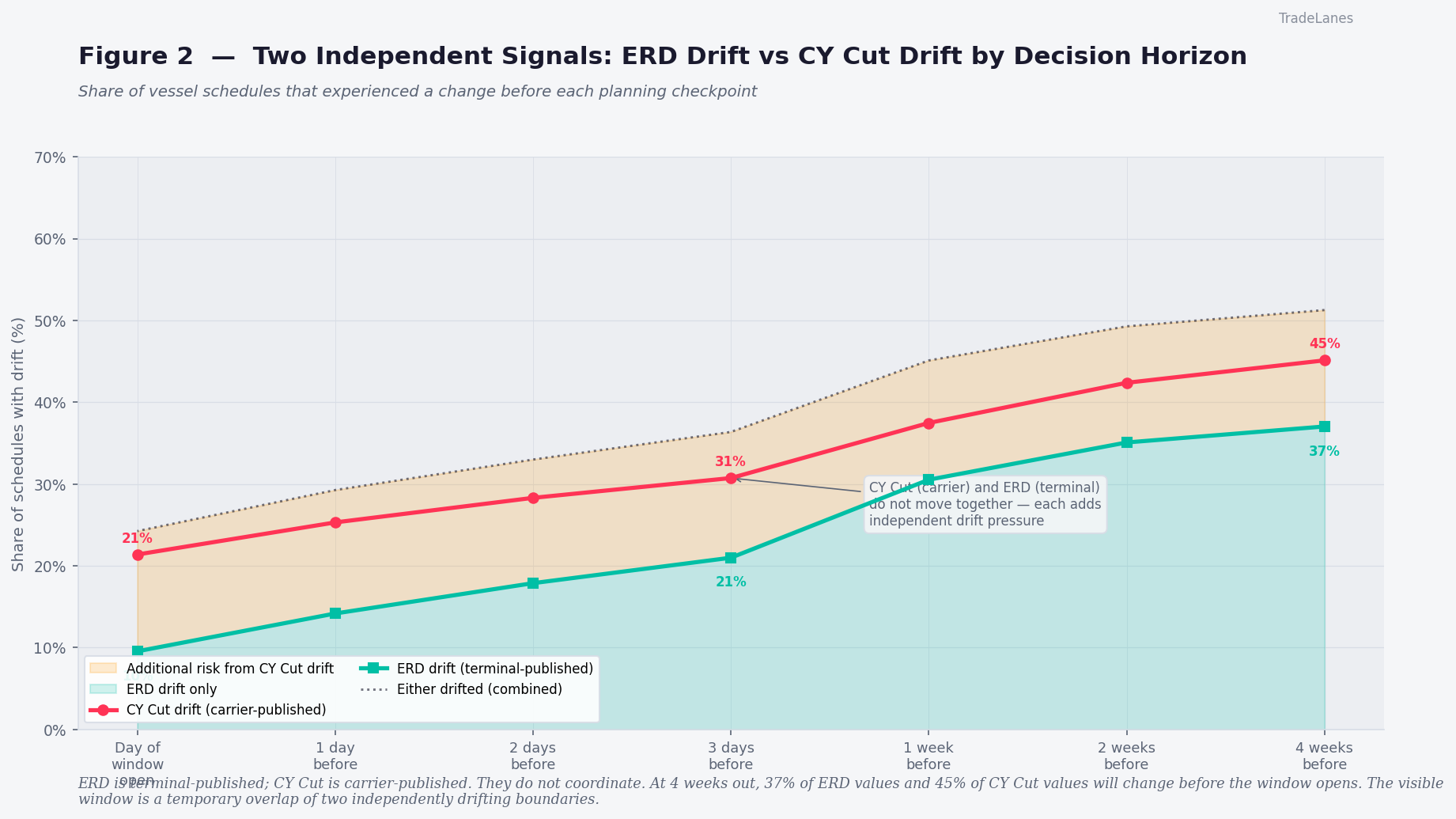
The window is not one signal. It is two signals moving at different speeds.
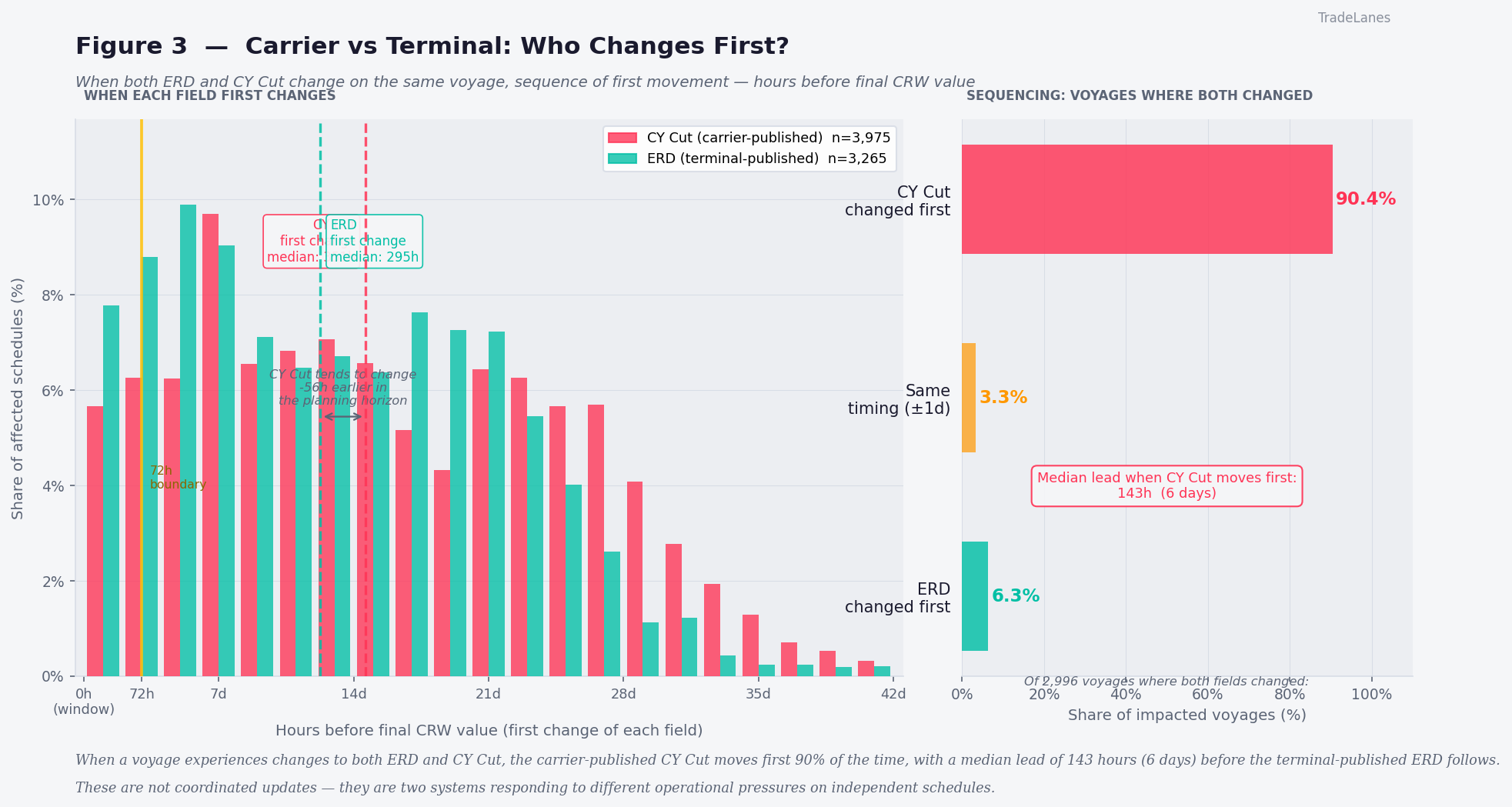
Figure 3 - Carrier vs Terminal: Who Moves First
CY Cutoff and ERD are not synchronized - when both change, the carrier moves first 9 times out of 10, and the terminal follows days later. The window was never one thing.
The system-level pattern
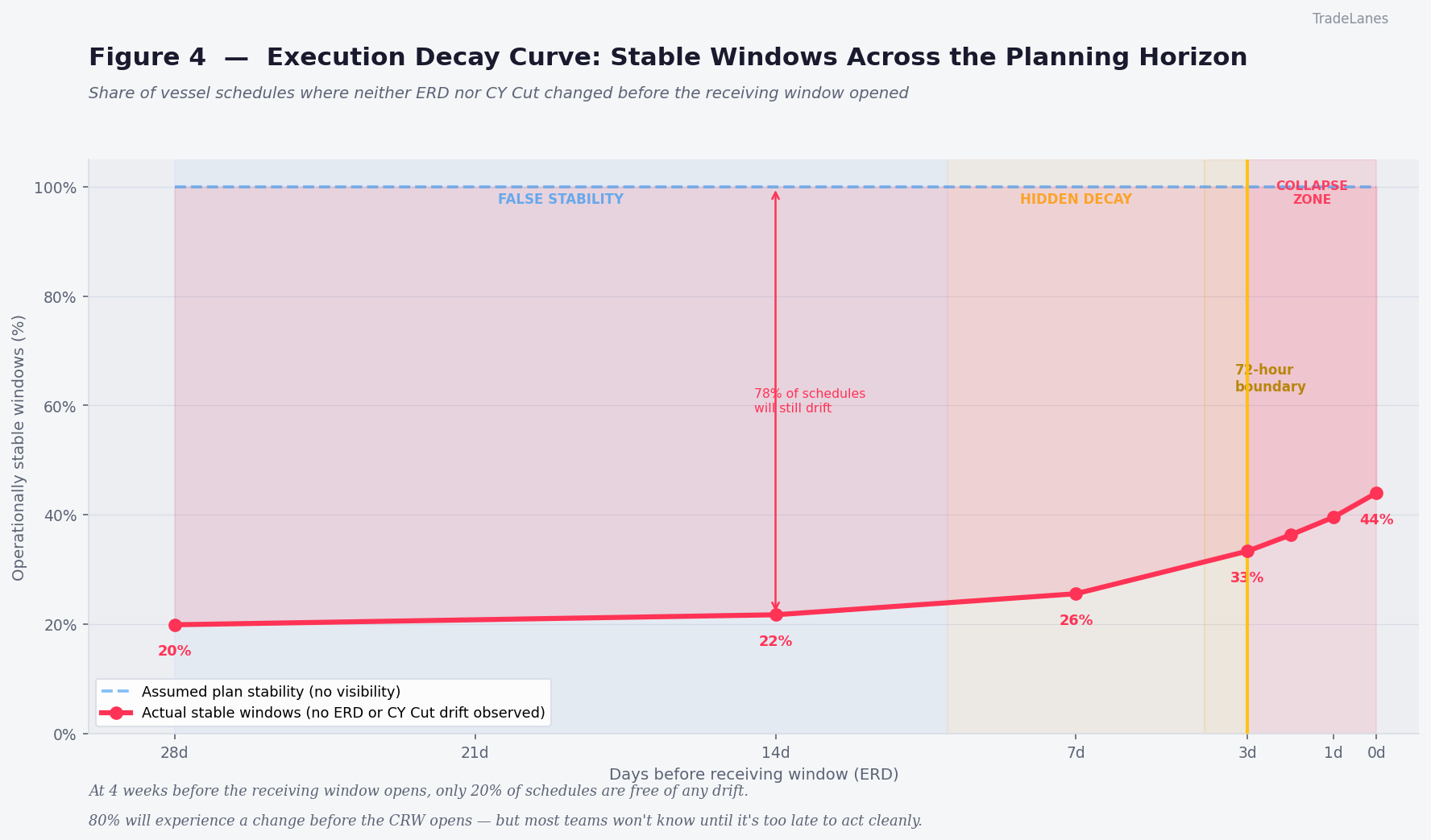
Across thousands of voyages, the pattern is consistent:
- Windows appear stable early
- Drift accumulates quietly
- Decision space compresses
- Failure appears suddenly
This is not randomness.
This is structure.
This is where the pattern becomes visible at scale.
Figure 4 - Execution Decay Curve (Light Background Version)
The 72-hour boundary
There is a point where this stops being manageable.
And becomes irreversible.
That point is not the vessel departure.
It is not the CY Cut.
It is not when the booking rolls.
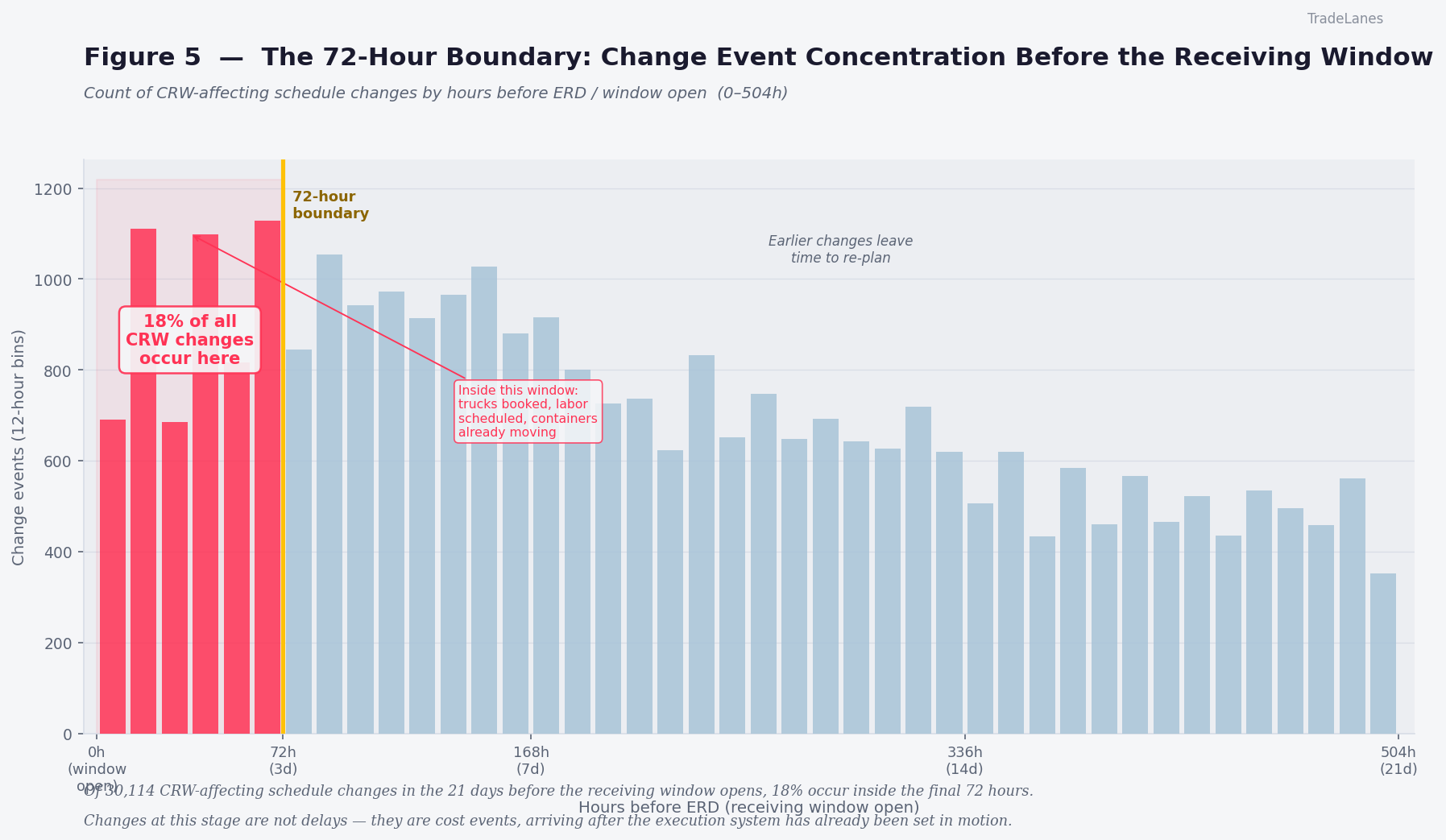
It is: Inside the final 72 hours before the receiving window opens.
At this point:
- trucks are already booked
- labor is already scheduled
- containers are already moving
The system is no longer planning.
It is executing.
And any change now is not a delay.
It is a cost event.
This is where decision space collapses.
Figure 5 - The 72-Hour Boundary (Decision Compression Zone)
What this means operationally
When a change happens inside this boundary:
There is no clean recovery path.
Only degraded options:
- re-dispatch
- storage
- missed cutoff
- roll to next vessel
The outcome feels sudden.
But the conditions that caused it: Were already in motion long before.
Why monitoring does not fix this
Monitoring does not fix this.
You can check once a day, twice a day, continuously.
But the signal does not arrive evenly.
It arrives in clusters - often after the decision space has already narrowed.
The real failure point
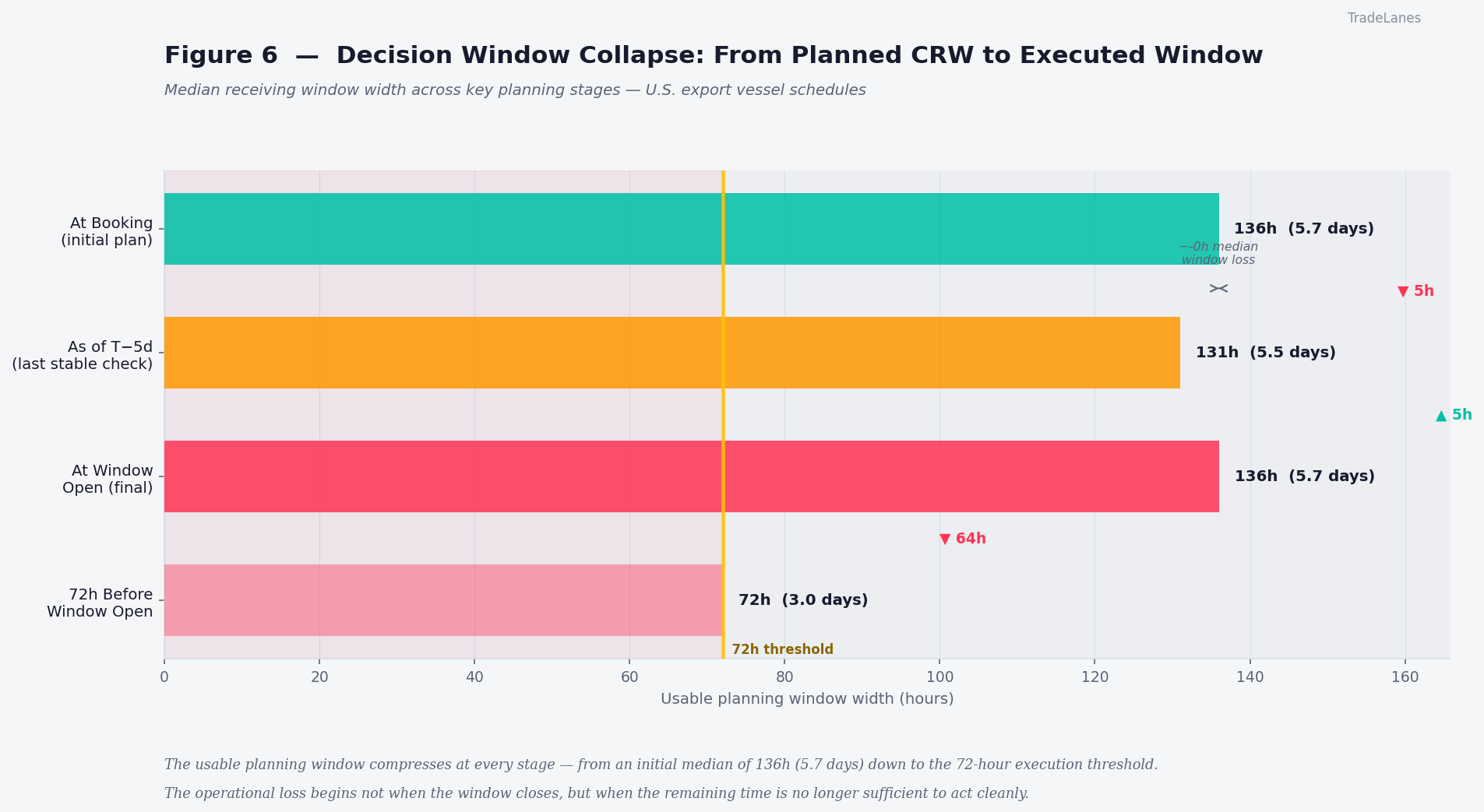
The system does not fail when the window closes.
It fails when the window becomes unreliable.
That happens earlier.
Often much earlier.
This is how the decision window collapses before failure becomes visible.
Figure 6 - Decision Window Collapse Timeline (ERD → CY Cut)
The uncomfortable conclusion
Most export teams are not making bad decisions.
They are making rational decisions: On invalid windows.
The new lens
You are not deciding: “What changed?”
You are deciding: “Is this window still safe to act on?”
Until reliability is measured at the receiving window, not vessel arrival, exporters will continue to plan against windows that do not hold.
And decisions will continue to be made on plans that were already broken.
Failure appears sudden. The decay that causes it is not.



Leave a Comment