Why “On-Time” Stops Working the Moment Cargo Hits the Yard
System Baseline Edition
About the Carrier Reliability Series
This article establishes the baseline for how TradeLanes analyzes ocean carrier reliability.
Most industry metrics still evaluate reliability at arrival. This series examines what happens before that - inside the cargo receiving window, where exporters actually make or miss sailings.
Subsequent articles apply this framework to:
-
Individual carriers
-
Terminal-specific behavior
-
ERD and CY Cutoff volatility patterns
-
Where “on-time” metrics diverge from execution reality
If you’re reading this for the first time, start here. The articles below build on this foundation.
Continue the series:
- When Did Every Schedule Change Become an “Exception”?
- The Reliability Illusion: The Gemini Edition
-
The Reliability Illusion: MSC Through the Cargo Receiving Window
-
The Reliability Illusion: ONE Through the Cargo Receiving Window
Why this article exists (before we look at any charts)
Most discussions of ocean carrier reliability still revolve around a single question:
Did the vessel arrive on time?
That question is easy to measure.
It is also the wrong one for exporters.
Export execution happens inside the receiving window - the time period between the Earliest Return Date (ERD) and the CY Cutoff. That window determines whether cargo can actually gate in, whether trucks are dispatched correctly, and whether a booking makes the intended sailing.
When that window moves, exporters feel it immediately - even if the vessel still arrives “on time.”
All terms used in this article - including ERD, CY Cutoff, receiving window, drift, and late-stage change - are defined in the Reliability Series - Methodology Appendix:
https://www.tradelanes.co/blog/reliability-series-methodology-appendix
This article establishes the system baseline: how receiving-window reliability behaves across all carriers and terminals, after removing data errors and requiring both ERD and CY to be present.
Every carrier deep dive that follows applies this same framework at the 1,000-ft level.
Data scope (after validation filters)
The dataset represents an observational system sample of executable export port-calls and is not a statistically randomized sample.
- 5,441 port-calls
- 1,357 vessels
- 39 carriers
- 12 U.S. export terminals
Filters applied:
- Both ERD and CY Cutoff required
- Drift greater than 40 days treated as data error and excluded
Full methodology, thresholds, and definitions are documented here:
https://www.tradelanes.co/blog/reliability-series-methodology-appendix
Section 1 - How often do receiving windows actually move?
A receiving window is considered moved if either the ERD or CY Cutoff shifts by one calendar day or more from its originally published value.
Figure 1 - Receiving Window Stability (System-Wide)
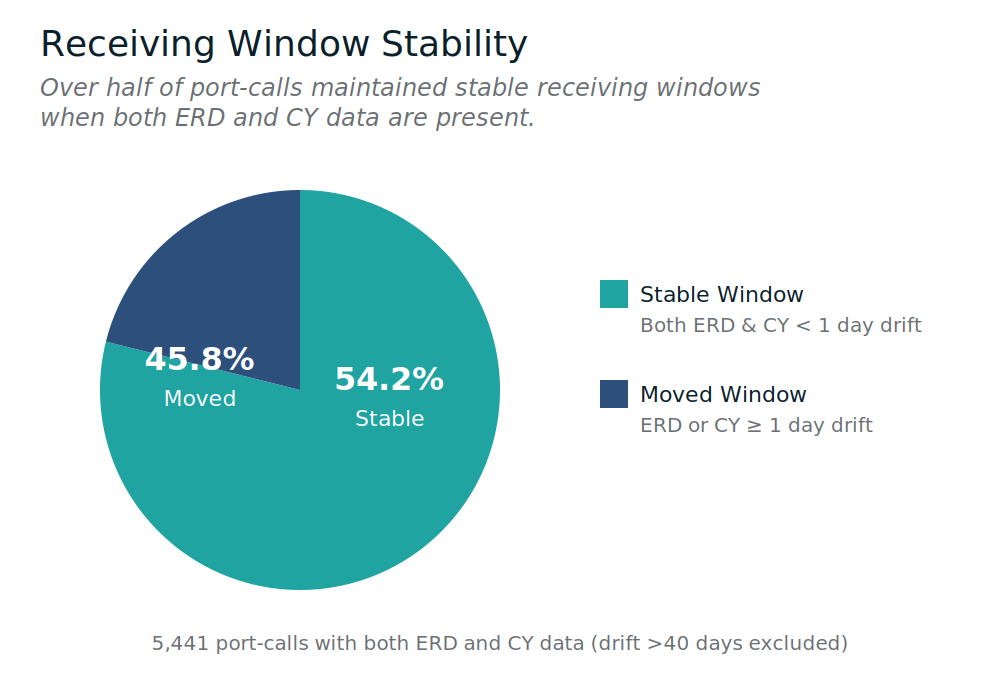
That alone explains why exporters can feel constant friction even in periods when headline ‘on-time arrival’ metrics look healthy.
- Stable receiving windows: 54.16%
- Moved receiving windows: 45.84%
Plain-English meaning:
Even after removing obvious data errors, nearly half of export receiving windows moved at least once.
This is the reliability illusion in its simplest form:
cargo plans can break even when headline “on-time arrival” metrics look healthy.
Section 2 - Drift isn’t chaos; it has a shape
Drift measures how far an ERD or CY Cutoff moves between its original and final values, expressed in calendar days.
Figure 2 - ERD Drift Distribution
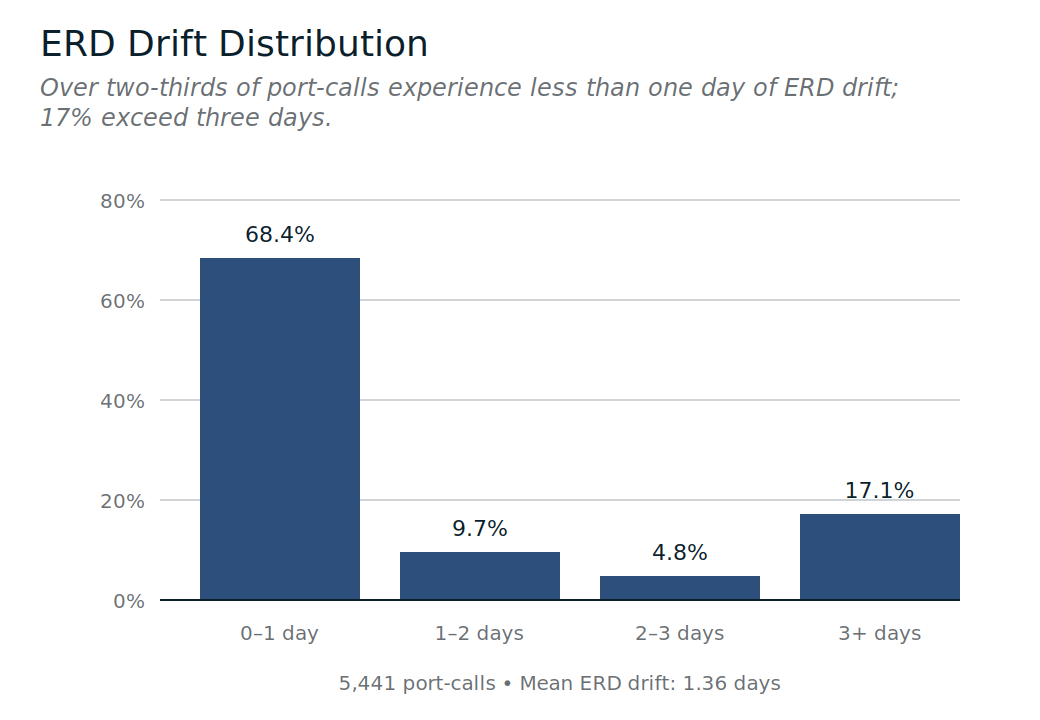
- 0-1 day: 68.41%
- 1-2 days: 9.69%
- 2-3 days: 4.83%
- 3+ days: 17.07%
Plain-English meaning:
Most ERD changes are small - but a meaningful long tail exists. Those larger shifts are infrequent, but when they occur, they overwhelm fixed planning assumptions.
Static buffers are built for the middle of the curve. Operational pain lives in the tail.
Section 3 - CY cutoffs are where risk concentrates
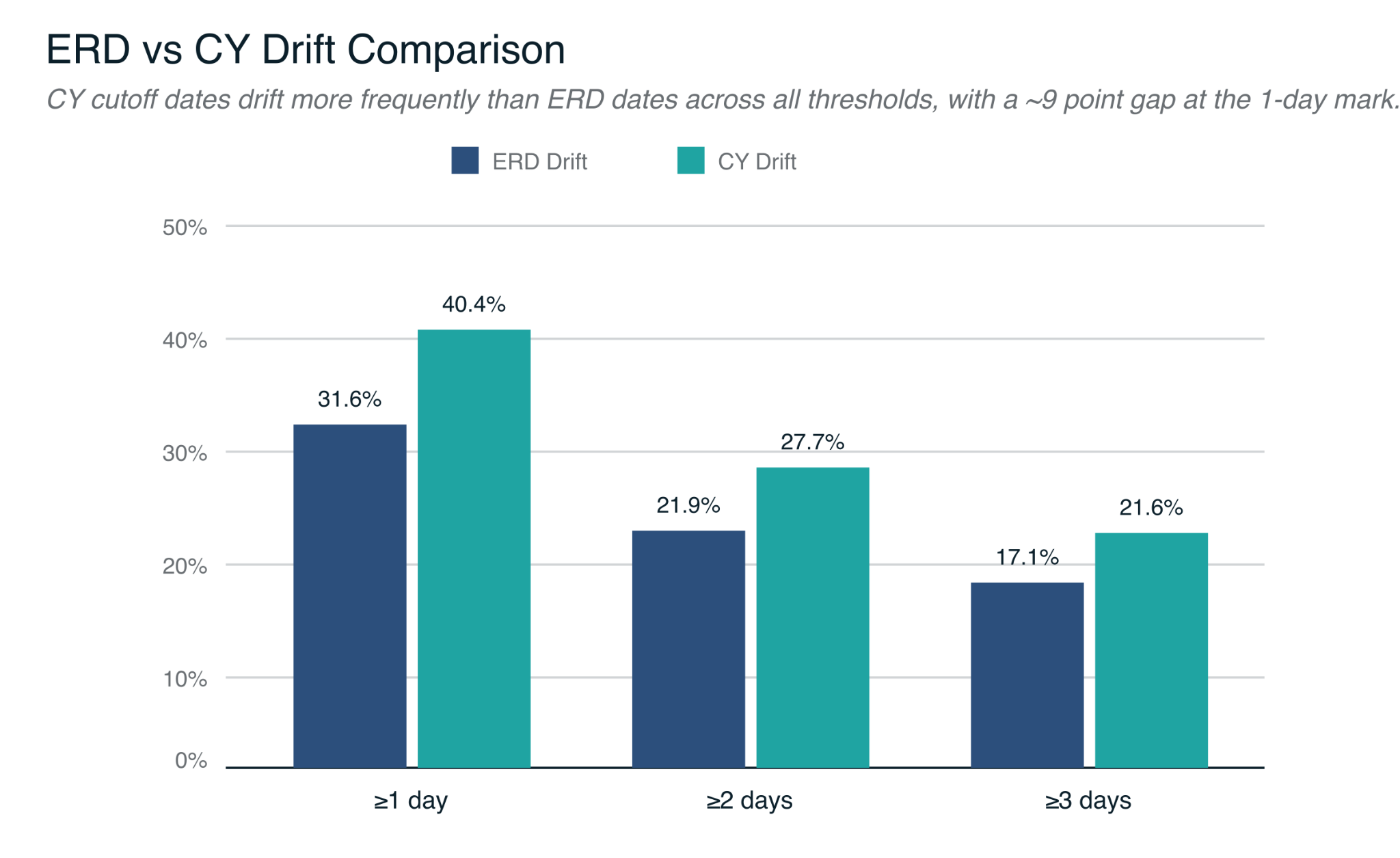
Across the system, CY Cutoff drift consistently exceeds ERD drift.
Figure 3 - ERD vs CY Drift (System Comparison)
Average drift
- Mean ERD drift: 1.36 days
- Mean CY drift: 1.66 days
Threshold comparison
- ≥1 day drift: ERD 31.59% vs CY 40.42%
- ≥2 days drift: ERD 21.91% vs CY 27.70%
- ≥3 days drift: ERD 17.07% vs CY 21.60%
Plain-English meaning:
Exporters often feel “safe” early because ERDs look stable - then get exposed later when CY Cutoffs move underneath them.
CY cutoffs move more often and by larger amounts than ERDs. That’s critical because CY is the last gate. Even small CY shifts can invalidate otherwise “safe” plans made earlier in the week.
If exporters feel blindsided late, this is why.
Section 4 - Timing matters more than averages
A late-stage change is defined as a change to ERD or CY Cutoff that occurs within the final 72 hours before the receiving window opens.
Figure 4 - Late-Stage Receiving-Window Changes
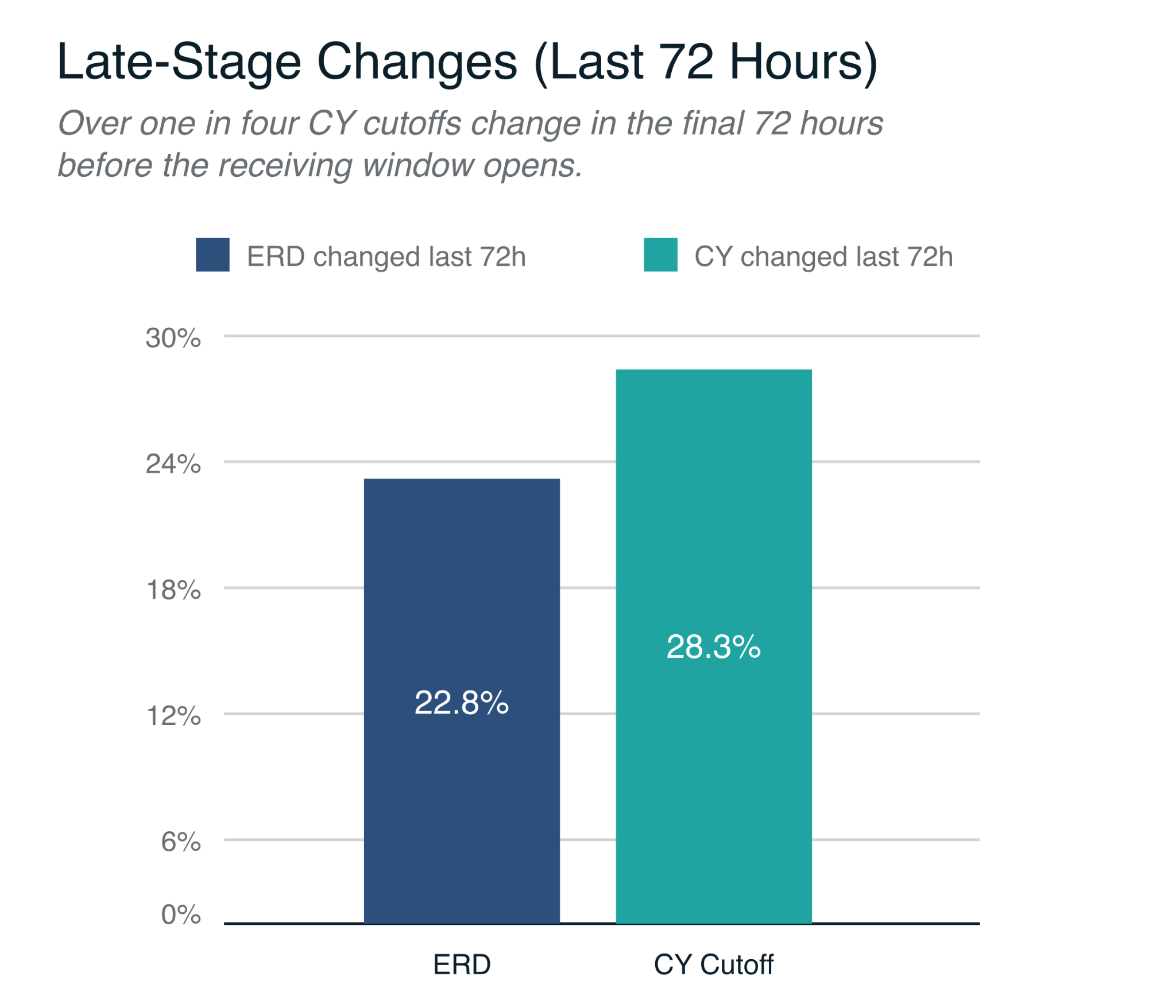
- ERD changed in last 72 hours: 22.75%
- CY Cutoff changed in last 72 hours: 28.27%
Plain-English meaning:
More than 1 in 4 CY Cutoffs changed inside the final three days - when trucks, labor, and documentation are already locked.
So far, we’ve looked at how windows move. Next, we look at where.
Section 5 - Volatility is not evenly distributed across terminals
Some ports are simply harder to plan against than others. That’s what the Port Volatility Index (PVI) captures.
PVI combines:
- how far ERDs move,
- how far CY cutoffs move, and
- how often changes happen late,
into a normalized score (0-10) that reflects how quickly static planning assumptions break at a port.
A higher PVI doesn’t mean a port is “bad.” It means static assumptions break faster there.
Figure 5 - Port-Level Drift (Top Volatility Ports)
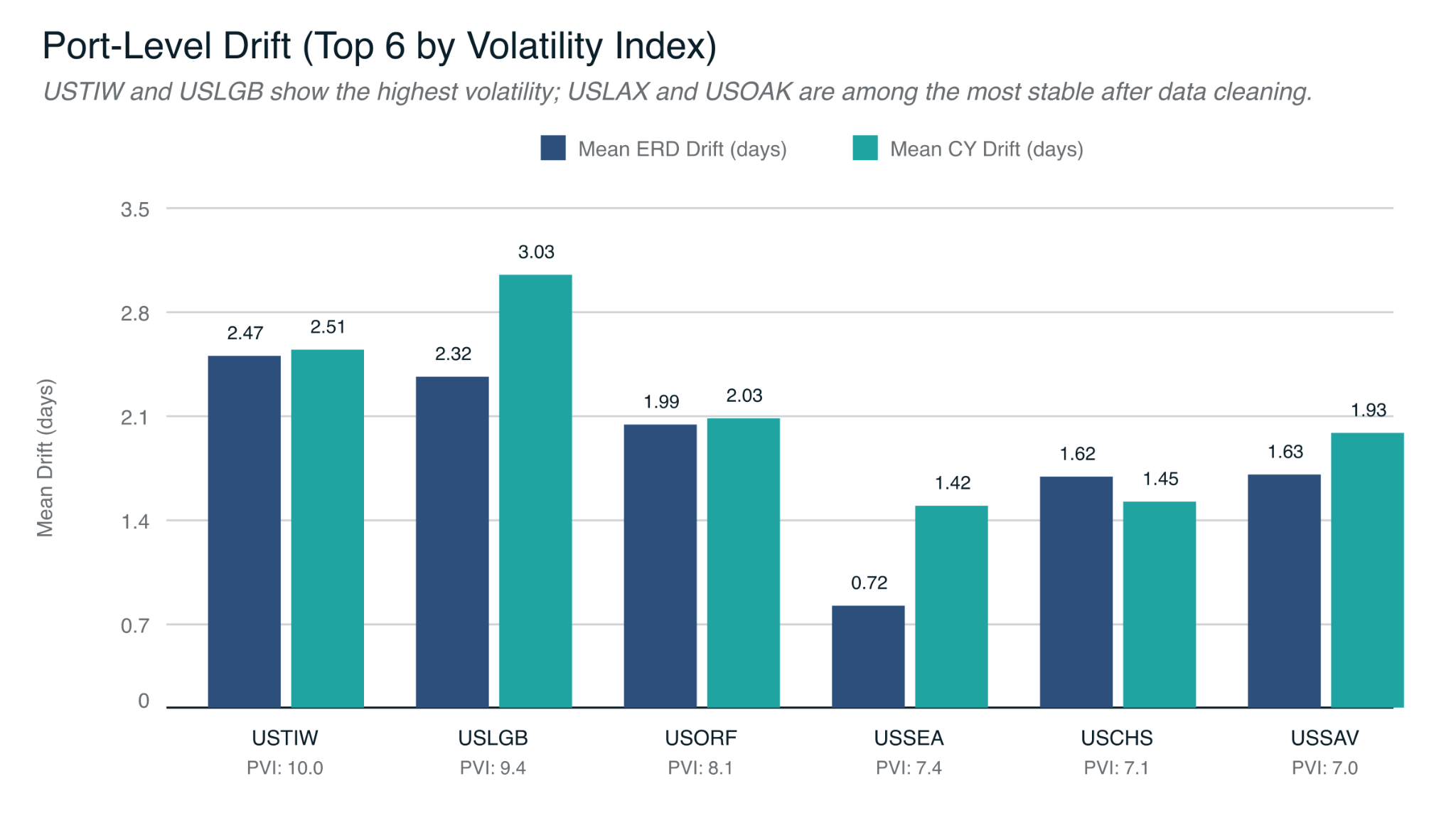
USTIW (PVI 10.0) - High-magnitude movement, low forgiveness
Both ERD and CY move by more than two days on average - the highest combined drift observed.
What this feels like:
Even early plans can get invalidated. When things move here, they move far.
USLGB (PVI 9.4) - CY volatility dominates
ERDs look manageable, but CY cutoffs slide by more than three days on average.
What this feels like:
Plans look fine until the last gate shifts underneath you.
USORF (PVI 8.1) - Frequent, medium-sized adjustments
Changes are common, even if they aren’t extreme.
What this feels like:
Constant re-validation. Planning fatigue builds over time.
USSEA (PVI 7.4) - ERD steady, CY less so
ERDs stay relatively stable. CY cutoffs don’t.
What this feels like:
Early signals look reassuring - final execution is not.
USCHS (PVI 7.1) - Moderate drift with late timing
Average drift is mid-range, but late-stage changes are meaningful.
What this feels like:
Things break close to execution, when flexibility is lowest.
USSAV (PVI 7.0) - Consistent movement, manageable range
Both ERD and CY move by about 1.5-2 days.
What this feels like:
Movement is expected. Adaptability matters more than precision.
Section 6 - Severity still exists, even after cleaning
Figure 6 - Top 10 Highest-Severity Vessel Events
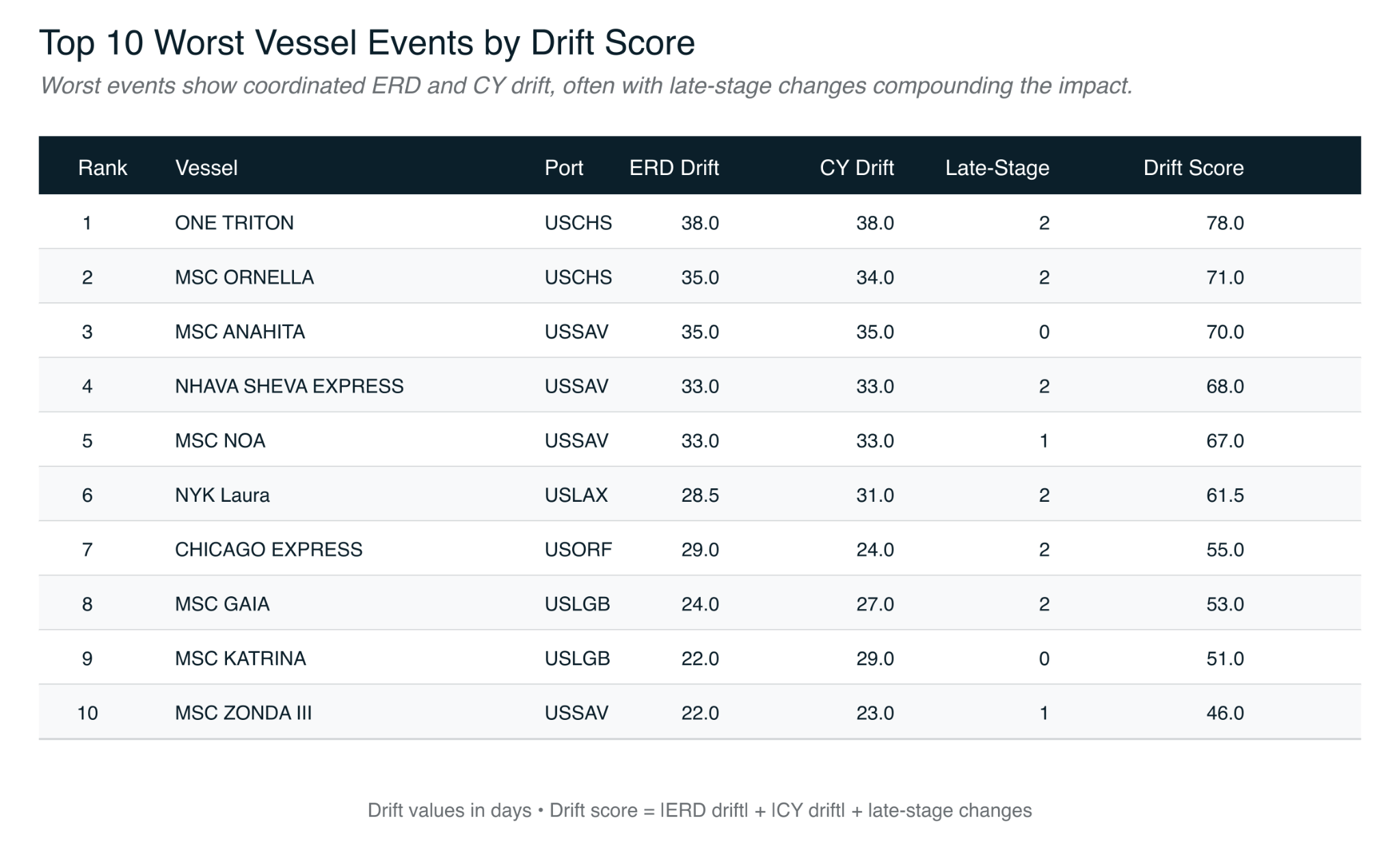
Plain-English meaning:
These events are not typical - they are stress tests that show how quickly drift can stack when multiple changes coincide.
Static buffers fail in these scenarios by design.
Section 7 - The KPI that actually matters
Figure 7 - Receiving Window Movement Rate
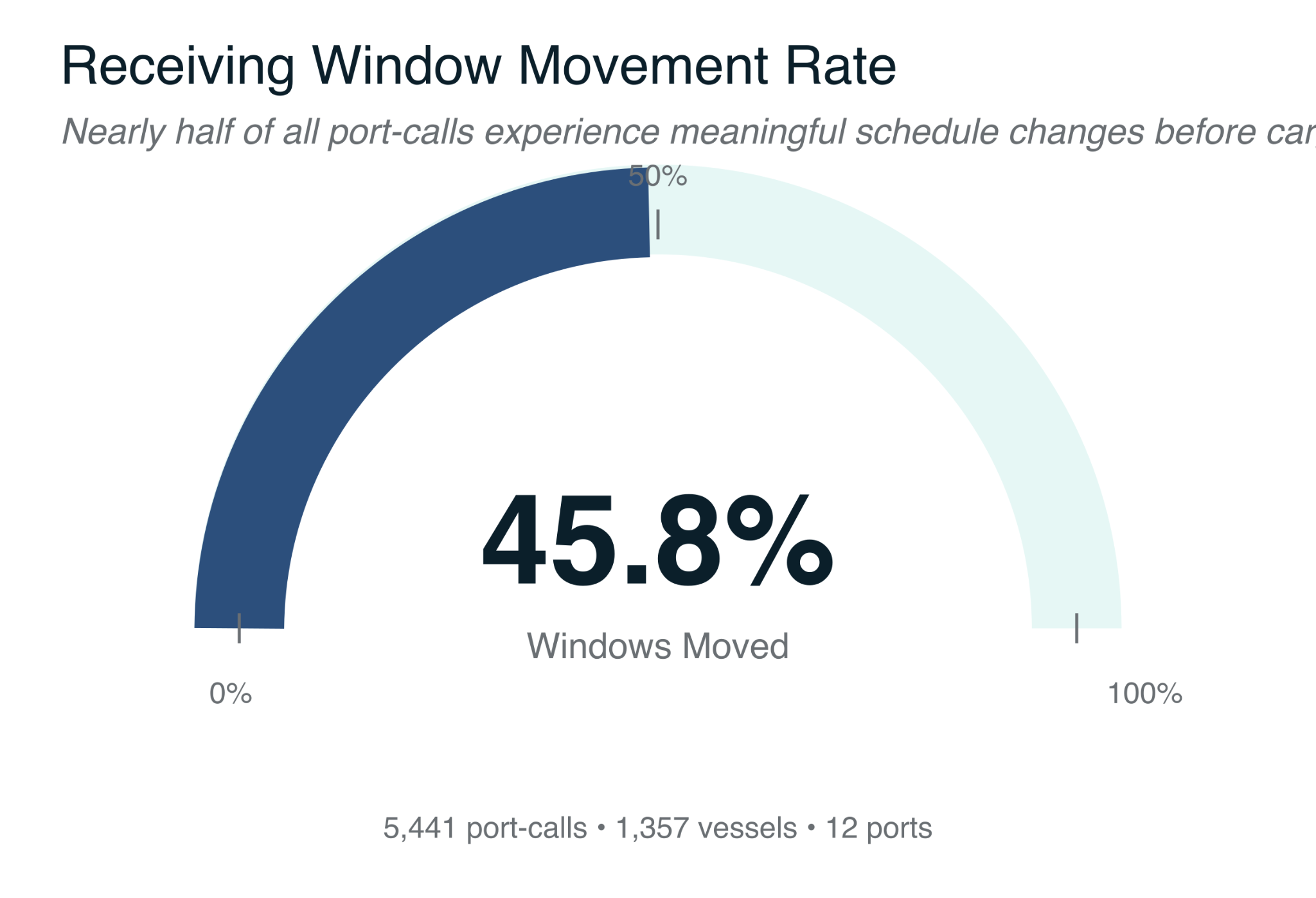
- 45.84% of receiving windows moved
- 54.16% remained stable
- Scope: 5,441 port-calls • 1,357 vessels • 12 ports
Plain-English meaning:
The core reliability constraint for exporters is predictability, not punctuality.
Section 8 - Why static buffers fail
Figure 8 - Static Buffer vs Dynamic Time Buffer (DTB)
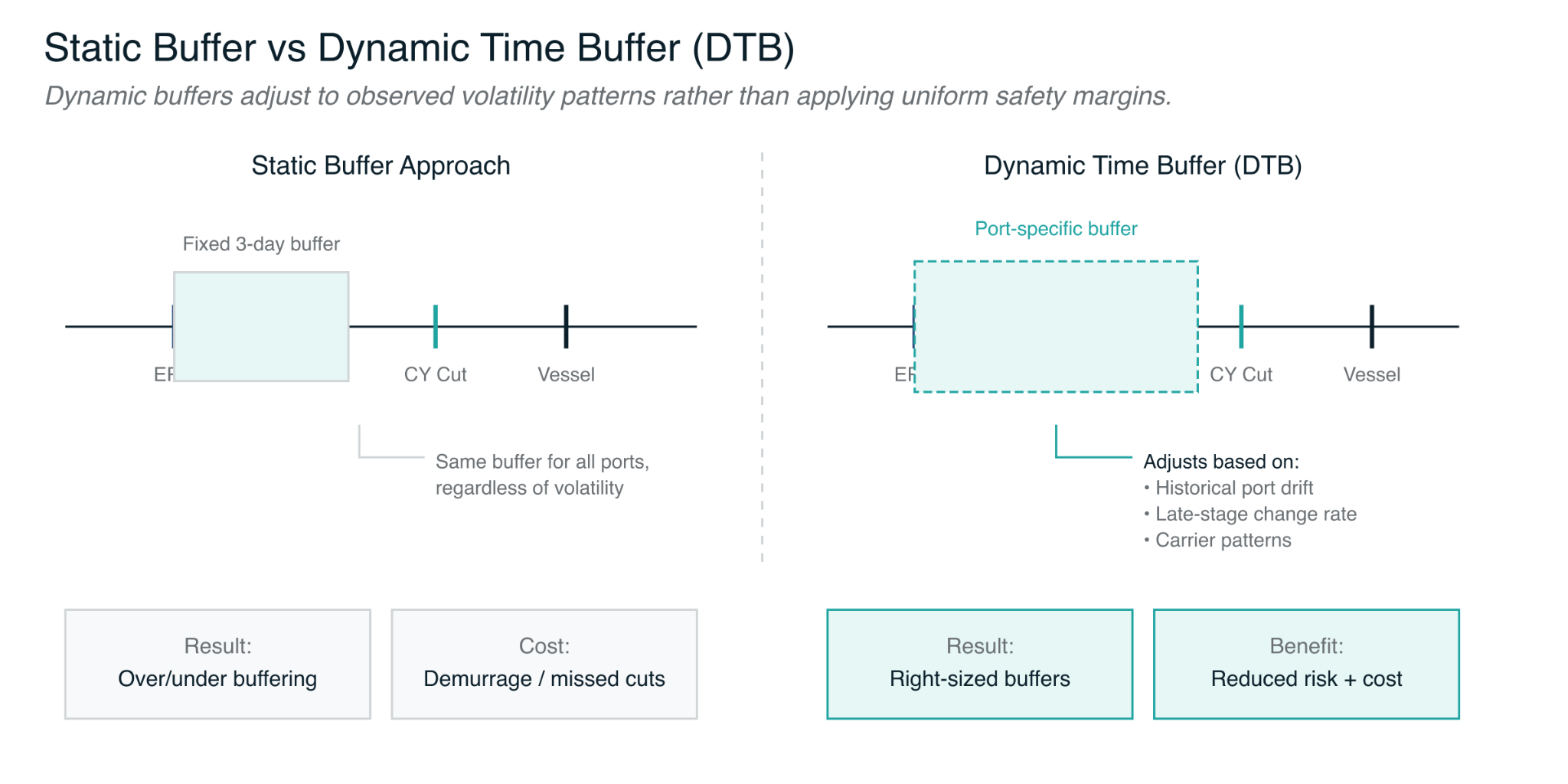
Plain-English meaning:
When drift has a long tail and late-stage changes are common, fixed buffers are routinely exceeded. Planning must adapt to observed behavior, not assumptions.
Before we talk about carriers
A vessel can be “on time” and still break export execution if the receiving window shifts underneath it.
This System Baseline establishes where volatility lives, how it behaves, and why exporters feel friction even in good reliability periods.
Each carrier deep dive that follows applies this same framework - definitions, thresholds, and charts - to show how individual carriers behave inside these terminal environments.
Methodology & Definitions
All definitions, thresholds, formulas, and exclusions used in this analysis are documented here:
Reliability Series - Methodology Appendix
https://www.tradelanes.co/blog/reliability-series-methodology-appendix
Next in the Carrier Reliability Series
MSC - publishing soon.





Leave a Comment